Skip to main content
General Biology
나의 코스
배우기
시험 준비
AI 튜터
학습 가이드
교과서적 해결책
플래시카드
탐험해 보세요
앱을 사용해 보세요
나의 코스
배우기
시험 준비
AI 튜터
학습 가이드
교과서적 해결책
플래시카드
탐험해 보세요
앱을 사용해 보세요
뒤로
DNA Structure and Replication - General Biology
카드를 뒤집기 위해 탭할 수 있습니다.
Watson & Crick Model of DNA
카드를 뒤집기 위해 탭할 수 있습니다.
👆
Watson & Crick Model of DNA
DNA is a
double helix
with antiparallel strands held together by hydrogen bonds between complementary bases (A-T, G-C).
진행 상황 추적
컨트롤 버튼이 '내비게이션' 모드로 변경되었습니다.
1/21
추천 영상
08:56
The Griffith Experiment
17753
views
261
rank
이 집합의 용어 (21)
하이드의 정의
Watson & Crick Model of DNA
DNA is a
double helix
with antiparallel strands held together by hydrogen bonds between complementary bases (A-T, G-C).
Purpose of DNA Replication
To ensure
genetic information
is accurately passed to daughter cells during cell division.
Griffith's Transformation Experiment
Showed that a
transforming principle
from dead pathogenic bacteria could genetically alter live non-pathogenic bacteria.
Hershey-Chase Experiment
Used radioactive isotopes to show that
DNA, not protein
, is the genetic material injected by phages into bacteria.
Chargaff's Rules
1. Base composition of DNA varies between species. 2. In any species, % of A = T and % of G = C.
Role of Rosalind Franklin
Produced
X-ray crystallographic images
of DNA that enabled Watson and Crick to deduce the double helix structure.
Telomeres
Special nucleotide sequences at the ends of eukaryotic chromosomes that
postpone shortening
during replication.
Telomerase
An enzyme that
lengthens telomeres
in germ cells; inactive in most somatic cells but active in many cancer cells.
Chromatin
Complex of DNA and histone proteins; includes
euchromatin
(loosely packed, active) and
heterochromatin
(densely packed, inactive).
Semi-Conservative Model of DNA Replication
Each new DNA molecule has one old (parental) strand and one newly synthesized strand.
Replication Fork
Y-shaped region where DNA strands are separated and replication occurs.
Key Enzymes in DNA Replication
Helicase
unwinds DNA;
Primase
synthesizes RNA primer;
DNA polymerase
adds nucleotides;
Topoisomerase
relieves strain;
DNA ligase
joins fragments.
Direction of DNA Synthesis
DNA polymerase adds nucleotides only to the
3’ end
, synthesizing DNA in the 5’ to 3’ direction.
Leading vs Lagging Strand
Leading strand is synthesized
continuously
; lagging strand is synthesized
discontinuously
as Okazaki fragments.
Okazaki Fragments
Short DNA fragments synthesized on the lagging strand during DNA replication.
DNA Polymerase Proofreading
DNA polymerases
proofread
newly made DNA, replacing incorrect nucleotides to reduce errors.
Mismatch Repair
Enzymes correct errors missed by DNA polymerase to maintain DNA integrity.
Nucleotide Excision Repair
Removes and replaces damaged DNA segments caused by chemical or physical agents.
DNA Cloning
Inserting DNA into plasmids to create recombinant DNA using
restriction enzymes
and cloning vectors.
Polymerase Chain Reaction (PCR)
Technique to amplify specific DNA segments using cycles of denaturation, annealing, and extension with heat-stable DNA polymerase.
CRISPR-Cas9 System
A genome editing tool using guide RNA to direct Cas9 nuclease to target DNA sequences for cutting and modification.
 뒤로뒤로
뒤로뒤로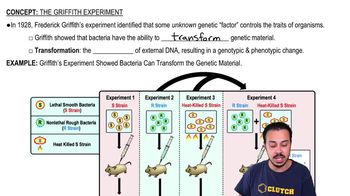
 08:56
08:56