 뒤로
뒤로Energetics & Enzymes in General Biology
 04:21
04:21
이 집합의 용어 (22)
Reception, Transduction, and Response.
GPCRs bind signaling molecules, activate G proteins, which then activate other proteins to propagate the signal inside the cell.
RTKs form dimers upon ligand binding and phosphorylate tyrosines, activating multiple relay proteins and triggering several pathways.
They open or close in response to ligand binding, regulating ion flow across the membrane to generate a cellular response.
Small molecules that diffuse through the cytosol to amplify signals, e.g., cyclic AMP (cAMP) and Ca2+.
Apoptosis is programmed cell death triggered by signaling pathways activating enzymes like caspases to orderly dismantle the cell.
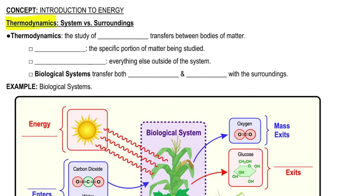
Metabolism is all chemical reactions in a cell; catabolic pathways break down molecules releasing energy, anabolic pathways build molecules requiring energy.
Energy can be transferred and transformed but cannot be created or destroyed in living organisms.
Every energy transfer increases entropy; organisms must expend energy to maintain order and fight entropy.
A negative ΔG means the reaction is spontaneous and releases free energy.
Chemical work (building molecules), transport work (active transport), and mechanical work (movement like muscle contraction).
ATP consists of adenine, ribose sugar, and three phosphate groups.
ATP + H2O → ADP + Pi + energy (ΔG = -7.3 kcal/mol), releasing energy for cellular work.
The minimum energy required to start a reaction by reaching the transition state.
Enzymes lower activation energy, increasing reaction rate without changing ΔG.
A flexible pocket formed by the enzyme's tertiary structure where substrates bind and the reaction occurs.
Cofactors are non-protein elements like ions or vitamins (e.g., iron, magnesium, vitamin C) that assist enzyme function.
High heat denatures enzymes; cold slows activity. Extreme pH can denature enzymes or reduce activity.
Increasing substrate increases product formation until enzyme saturation, after which activity plateaus.
Competitive inhibitors bind the active site blocking substrate; noncompetitive inhibitors bind elsewhere changing enzyme shape.
Binding of regulatory molecules at sites other than the active site that activate or inhibit enzyme activity by changing its shape.
The end product of a pathway inhibits an enzyme early in the pathway to regulate its own production.