뒤로

EXAM #3 SLIDES 3&4

컨트롤 버튼이 '내비게이션' 모드로 변경되었습니다.
1/29
  • What are the three basic organs of vascular plants?

    Roots, stems, and leaves.
  • What are the three main functions of roots?

    1) Anchor the plant to the soil, 2) Absorb water and nutrients, 3) Store products of photosynthesis.
  • What is the difference between a taproot system and a fibrous root system?

    Taproot system has a main primary root with lateral roots; fibrous root system has adventitious roots from stems or leaves and lateral roots from them.
  • What are root hairs and their function?

    Elongated extensions of epidermal root cells that increase surface area for absorption.
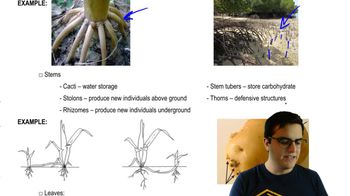
  • Name some root modifications and their functions.

    Pneumatophores (gas exchange), prop roots (support), storage roots (store nutrients), buttress roots (support).
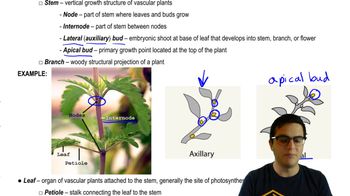
  • What is a stem and what are its main parts?

    An organ with alternating nodes (attachment points) and internodes (stem segments between nodes).
  • What is the function of an axillary bud?

    Can form a lateral branch, thorn, or flower.
  • Give examples of modified stems.

    Rhizomes, stolons, and tubers.
  • What are the main parts of a leaf?

    Flattened lamina and petiole (stalk connecting leaf to stem node).
  • How do monocot and dicot leaves differ in vein arrangement?

    Monocots have parallel venation; dicots have netlike venation.
  • What are some examples of modified leaves and their functions?

    Tendrils (climbing), spines (protection), reproductive leaves, storage leaves.
  • What are the three major tissue systems in plants?

    Dermal (outer layer), ground (middle layer), vascular (inner layer).
  • What tissues are included in the dermal tissue system?

    Cuticle, epidermis, stomata with guard cells, and trichomes.
  • What are the main components of ground tissue?

    Pith and cortex; cells specialized for photosynthesis, support, and storage.
  • What tissues make up the vascular tissue system?

    Xylem and phloem.
  • What is meristematic tissue?

    Undifferentiated cells that divide and contribute to plant growth.
  • What is the role of apical meristems?

    Located at tips of roots and shoots; enable elongation (primary growth).
  • What is the role of lateral meristems?

    Facilitate growth in thickness or girth (secondary growth).
  • Describe the zones of growth in a root tip.

    Zone of cell division, zone of elongation, and zone of differentiation.
  • Where do lateral roots arise from?

    From the pericycle, the outermost layer of the vascular cylinder.
  • What is the shoot apical meristem and what develops from it?

    A dome-shaped mass of dividing cells at shoot tip; leaves develop from leaf primordia and axillary buds from meristematic cells at leaf bases.
  • What is the function of stomata in leaves?

    Facilitate gas exchange and regulate water loss.
  • How do guard cells regulate stomata?

    By changing turgor pressure; turgid guard cells open stomata, flaccid cells close them.
  • What tissues are produced by the vascular cambium during secondary growth?

    Secondary xylem (wood) and secondary phloem.
  • What does the cork cambium produce?

    A protective covering of waxy cells called periderm.
  • How do primary and secondary growth differ in plants?

    Primary growth lengthens roots and shoots; secondary growth increases thickness.
  • What is the function of the root cap?

    Protects the apical meristem as the root pushes through soil.
  • What is the stele in roots?

    The central vascular tissue region containing xylem, phloem, and pericycle.
  • What is the difference between primary and secondary xylem?

    Primary xylem forms during primary growth; secondary xylem forms during secondary growth and contributes to wood.