 뒤로
뒤로Functional Groups in General Biology
 02:00
02:00
이 집합의 용어 (7)
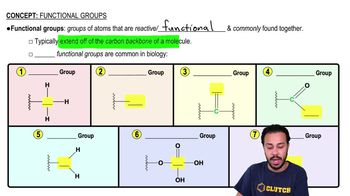
Hydroxyl group
Is polar due to electronegative oxygen and forms hydrogen bonds with water, helping dissolve compounds like sugars. Compound name: Alcohol (usually ends in -ol). Example: Ethanol.
(—OH)
Carbonyl group
Sugars with ketone groups are called ketoses; those with aldehydes are aldoses. Compound name: Ketone (within carbon skeleton) or aldehyde (at end of skeleton). Examples: Acetone (ketone), Propanal (aldehyde).
(>C=O)
Carboxyl group
Acts as an acid (can donate H+) because the covalent bond between oxygen and hydrogen is polar. Compound name: Carboxylic acid or organic acid. Example: Acetic acid.
(—COOH)
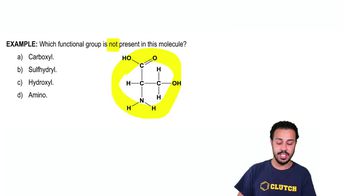
Amino group
Acts as a base; can pick up an H+ from the surrounding solution. Compound name: Amine. Example: Glycine (an amino acid).
(—NH2)
Sulfhydryl group
Two —SH groups can react to form a cross-link that stabilizes protein structure, affecting hair shape. Compound name: Thiol. Example: Cysteine (a sulfur-containing amino acid).
(—SH)
Phosphate group
Contributes negative charge (1− or 2−) depending on position. Confers ability to react with water, releasing energy. Compound name: Organic phosphate. Example: Glycerol phosphate.
(—OPO32−)
Methyl group
Affects gene expression when on DNA or proteins bound to DNA. Influences shape and function of male and female sex hormones. Compound name: Methylated compound. Example: 5-Methylcytosine.
(—CH3)