 뒤로
뒤로Fundamentals of Biology - Properties of Life and Cell Types
 09:26
09:26
이 집합의 용어 (19)
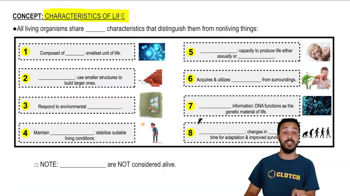
Life is membrane delimited, made of cells, stores and follows instructions, stores and uses energy, is self-replicating, controls functions and responds to the environment, and evolves.
Lipids provide a selectively permeable membrane barrier, compartmentalization, energy storage, and insulation.
Lipids, carbohydrates, nucleic acids, and proteins support the properties of life by storing energy, information, and facilitating cellular functions.
Nucleic acids store and transmit genetic information essential for self-replication and cellular function.
Life stores and uses energy by converting it into ATP, which cells use to perform work.
Energy for life comes from sunlight or organic compounds like carbohydrates, lipids, and proteins.
Proteins control cellular functions and enable responses to environmental changes.
Evolution is the change in heritable characteristics of biological populations over successive generations.
The cell is the smallest unit that exhibits all properties of life.
Prokaryotes have no nucleus, circular DNA, small size (0.1-5 microns), often lack membrane-bound organelles, and replicate quickly.
Eukaryotes have a nucleus, membrane-bound organelles, linear DNA organized in chromosomes, and are larger (1-100 microns).
Viruses partially fit life properties: they store and follow instructions, use energy, respond to environment, and evolve, but lack membranes and independent energy storage.
Membranes provide compartmentalization, controlling the internal environment and allowing selective exchange of materials.
Self-replication is the ability of life to produce copies of itself, facilitated by biomolecules like nucleic acids.
Cells use proteins to regulate biochemical reactions and respond to environmental signals.
Carbohydrates serve as energy sources and structural components in cells.
ATP (adenosine triphosphate) is the main energy currency used by cells to perform work.
Prokaryotic DNA is circular and free in the cytoplasm; eukaryotic DNA is linear and enclosed in a nucleus.
Evolution allows populations to adapt over generations, ensuring survival and diversity of life.