 뒤로
뒤로General Biology: Atoms, Elements, and Basic Chemistry
 02:13
02:13
이 집합의 용어 (20)
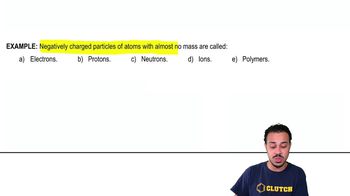
Protons (positive charge), neutrons (neutral), and electrons (negative charge).
Protons determine the atomic number and define the element.
Neutrons add mass and contribute to isotopes without changing the element.
Electrons determine chemical bonding and reactivity.
Carbon (organic molecules), Hydrogen (water, organic compounds), Oxygen (respiration), Nitrogen (proteins, DNA).
Atoms of the same element with different numbers of neutrons, affecting mass but not chemical properties.
An atom or molecule with a net electric charge due to loss or gain of electrons.
Bond formed by transfer of electrons between atoms, creating oppositely charged ions that attract.
Bond formed by sharing of electron pairs between atoms.
Weak attraction between a hydrogen atom covalently bonded to one electronegative atom and another electronegative atom.
It stabilizes structures like DNA and proteins, and affects water's properties.
Concentration measure: moles of solute per liter of solution, written as \(M\).
State where the rates of forward and reverse reactions are equal, so concentrations remain constant.
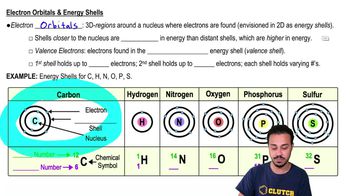
Electrons in the outer shell (valence electrons) determine how atoms bond.
The Sun provides energy for photosynthesis, supporting life on Earth.
Deoxyribonucleic acid, the molecule that stores genetic information in living organisms.
Ions differ in electron number (charge), isotopes differ in neutron number (mass).
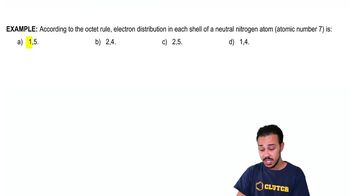
The number and arrangement of valence electrons.
They are shared or transferred to form chemical bonds between atoms.
Essential for cellular respiration, allowing organisms to produce energy.