Skip to main content
General Biology
나의 코스
배우기
시험 준비
AI 튜터
학습 가이드
교과서적 해결책
플래시카드
탐험해 보세요
앱을 사용해 보세요
나의 코스
배우기
시험 준비
AI 튜터
학습 가이드
교과서적 해결책
플래시카드
탐험해 보세요
앱을 사용해 보세요
뒤로
General Biology: Atoms, Molecules, and Chemical Bonds
카드를 뒤집기 위해 탭할 수 있습니다.
What determines the chemical reactivity of an atom?
카드를 뒤집기 위해 탭할 수 있습니다.
👆
What determines the chemical reactivity of an atom?
The electrons in the outermost or
valence shell
determine an atom's chemical reactivity.
진행 상황 추적
컨트롤 버튼이 '내비게이션' 모드로 변경되었습니다.
1/20
추천 영상
04:26
Recap: Prokaryotic vs. Eukaryotic Cells
21019
views
349
rank
05:54
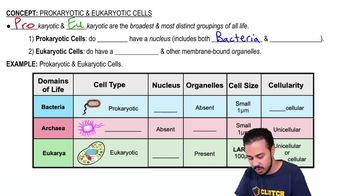
Prokaryotic & Eukaryotic Cells
35579
views
760
rank
4
comments
03:54
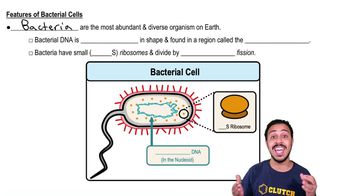
Features of Bacterial Cells
25379
views
435
rank
1
comments
이 집합의 용어 (20)
하이드의 정의
What determines the chemical reactivity of an atom?
The electrons in the outermost or
valence shell
determine an atom's chemical reactivity.
What is the maximum number of electrons in the first three electron shells?
Shell 1 holds up to 2 electrons, Shell 2 up to 8 electrons, and Shell 3 up to 8 electrons.
What makes an atom stable?
An atom is stable when its valence shell is
full
: 2 electrons in shell 1, 8 in shell 2, and 8 in shell 3.
What defines an element?
The
atomic number
, which is the number of protons in the nucleus, defines an element.
What is the relationship between protons and electrons in a neutral atom?
In a neutral atom, the number of protons equals the number of electrons.
How do atoms achieve stability through chemical bonds?
Atoms with incomplete valence shells interact by sharing, donating, or receiving electrons to complete their outer shells.
What are ionic bonds?
Ionic bonds form between ions with full positive or negative charges due to electron transfer.
What are covalent bonds?
Covalent bonds involve
sharing
of outer electrons between atoms; they can be polar or nonpolar.
What is the difference between polar and nonpolar covalent bonds?
Polar covalent bonds have unequal electron sharing with partial charges; nonpolar covalent bonds share electrons equally.
What is electronegativity?
Electronegativity is an atom's ability to attract shared electrons; higher electronegativity means stronger pull.
Which atoms are highly electronegative?
Oxygen and Nitrogen are highly electronegative atoms.
What type of bond forms between hydrogen (H) and chlorine (Cl) with electronegativities 2.1 and 3.0 respectively?
A
polar covalent bond
forms due to an electronegativity difference of 0.9.
What is the octet rule?
Atoms tend to gain, lose, or share electrons to have 8 electrons in their valence shell for stability.
How many covalent bonds can carbon form and why?
Carbon has 4 valence electrons and forms 4 covalent bonds to complete its octet.
What is a double bond in covalent bonding?
A double bond involves sharing two pairs of electrons between two atoms.
What is a triple bond in covalent bonding?
A triple bond involves sharing three pairs of electrons between two atoms.
What is the difference between oxidation and reduction in redox reactions?
Oxidation is the loss of electrons; reduction is the gain of electrons.
What is the significance of valence electrons in chemical bonding?
Valence electrons determine how atoms interact and bond to form molecules.
What is the structure of a water molecule (H2O)?
Two hydrogen atoms and one oxygen atom are joined by single covalent bonds forming a polar molecule.
What is the composition of sodium chloride (NaCl)?
NaCl is formed by ionic bonding between sodium cations (Na+) and chloride anions (Cl-).
 뒤로뒤로
뒤로뒤로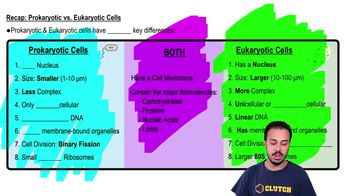
 04:26
04:26