Skip to main content
General Biology
나의 코스
배우기
시험 준비
AI 튜터
학습 가이드
교과서적 해결책
플래시카드
탐험해 보세요
앱을 사용해 보세요
나의 코스
배우기
시험 준비
AI 튜터
학습 가이드
교과서적 해결책
플래시카드
탐험해 보세요
앱을 사용해 보세요
뒤로
General Biology: Biomolecules and Protein Structure
카드를 뒤집기 위해 탭할 수 있습니다.
What are the four main classes of biomolecules essential for life?
카드를 뒤집기 위해 탭할 수 있습니다.
👆
What are the four main classes of biomolecules essential for life?
Proteins, nucleic acids, carbohydrates, and lipids
are the four main classes of biomolecules with specific functions in life.
진행 상황 추적
컨트롤 버튼이 '내비게이션' 모드로 변경되었습니다.
1/21
추천 영상
04:19
Building & Breaking-Down Polymers
23148
views
406
rank
3
comments
03:42
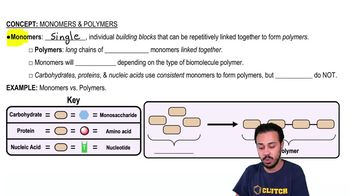
Monomers & Polymers
26446
views
562
rank
2
comments
이 집합의 용어 (21)
하이드의 정의
What are the four main classes of biomolecules essential for life?
Proteins, nucleic acids, carbohydrates, and lipids
are the four main classes of biomolecules with specific functions in life.
What is a polymer and how is it formed?
A polymer is a large molecule made by bonding together many monomers
through polymerization.
What is a condensation reaction in biomolecule synthesis?
A
condensation (dehydration) reaction
joins monomers by removing water (H and OH) to form a covalent bond.
What is hydrolysis in the context of biomolecules?
Hydrolysis
breaks polymers into monomers by adding water, reversing condensation reactions.
What are monosaccharides and their general formula?
Monosaccharides are the smallest sugars with the general formula \(C_n(H_2O)_n\), often 3-6 carbons.
How do monosaccharides join to form complex carbohydrates?
Monosaccharides join by
glycosidic bonds
formed in condensation reactions; bonds can be α or β depending on sugar form.
What determines polysaccharide branching patterns?
Branching depends on the type of glycosidic bonds:
β-1,4 bonds form linear chains
, while
α-1,4 and α-1,6 bonds form branched chains
.
What are the roles of carbohydrates in cells?
Carbohydrates store energy, provide structure, and serve as cell identity markers.
What are the monomers of proteins?
Proteins are polymers of
amino acids
, each with an amino group, carboxyl group, and unique R side chain.
What type of bond links amino acids in proteins?
Amino acids are linked by
peptide bonds
formed by condensation reactions.
What are the four levels of protein structure?
Primary
(amino acid sequence),
secondary
(α-helices and β-sheets),
tertiary
(3D folding), and
quaternary
(multiple subunits).
What stabilizes secondary protein structures?
Secondary structures are stabilized by
hydrogen bonds
between backbone amino and carboxyl groups.
What interactions stabilize tertiary protein structure?
Tertiary structure is stabilized by
disulfide bridges, ionic bonds, hydrogen bonds, van der Waals forces
between R groups.
What is quaternary protein structure?
Quaternary structure is the assembly of multiple folded polypeptide subunits into a functional protein.
What happens during protein denaturation?
Denaturation is the loss of 3D structure due to heat, pH, or chemicals, causing loss of function; some proteins can refold.
What role do molecular chaperones play in protein folding?
Molecular chaperones assist proteins in folding correctly and prevent misfolding or aggregation.
What are prions and how do they cause disease?
Prions are misfolded proteins that induce misfolding in normal proteins, leading to infectious diseases.
What are nucleotides composed of?
Nucleotides consist of a
nitrogenous base, a pentose sugar, and a phosphate group
.
How are nucleotides linked in nucleic acids?
Nucleotides are linked by
phosphodiester bonds
forming a sugar-phosphate backbone.
In which direction are nucleic acids synthesized?
Nucleic acids are synthesized in the
5’ to 3’ direction
.
What are the main functions of DNA and RNA?
DNA stores genetic information; RNA is involved in protein synthesis, regulation, and enzymatic functions.
 뒤로뒤로
뒤로뒤로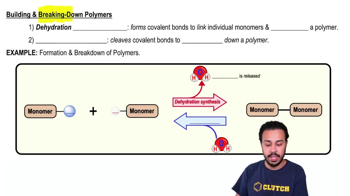
 04:19
04:19