Carbon has 4 valence electrons, allowing it to form 4 covalent bonds, enabling long chains, branches, and rings essential for large, varied biological molecules.
How many covalent bonds can carbon form and why is this important?
Carbon forms 4 covalent bonds, allowing complex structures like chains and rings, unlike hydrogen (1), oxygen (2), or nitrogen (3).
What shape does carbon form when bonded to 4 atoms with single bonds?
A tetrahedral shape, which is a 3D pyramid, not flat.
What happens to the shape of a molecule when two carbons share a double bond?
The molecule becomes flat/planar at the double bond.
Describe the structure of methane (CH4).
One carbon bonded to 4 hydrogens in a tetrahedral shape.
Describe the structure of ethane (C2H6).
Two carbons single-bonded to each other, each bonded to 3 hydrogens.
Describe the structure of ethene (ethylene, C2H4).
Two carbons double-bonded, each bonded to 2 hydrogens; molecule is flat.
List four ways carbon skeletons can vary.
Length, branching, position of double bonds, and presence of rings.
What are hydrocarbons and why are they important biologically?
Molecules of only carbon and hydrogen; they are hydrophobic and store large amounts of energy.
What are structural isomers?
Molecules with the same formula but different atom connectivity, e.g., pentane vs. 2-methylbutane.
What are cis-trans (geometric) isomers?
Isomers with the same bonds but different group arrangements around a double bond; cis groups on same side, trans on opposite sides.
What are enantiomers?
Mirror-image molecules that cannot be superimposed, labeled L (left) and D (right).
What is a functional group in biology?
A specific small group of atoms attached to a carbon skeleton that determines molecule behavior and properties.
How do functional groups affect molecules with the same carbon skeleton?
Different functional groups can cause molecules to behave very differently despite similar carbon skeletons.
 뒤로
뒤로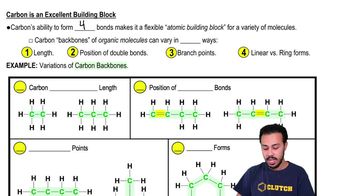
 03:35
03:35