 뒤로
뒤로General Biology: Carbon and Macromolecules
 03:35
03:35
이 집합의 용어 (29)
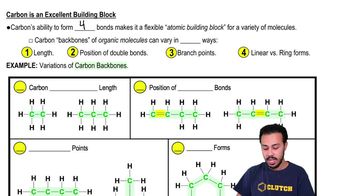
Carbon has four valence electrons allowing it to form four covalent bonds with atoms like H, O, N, and S, creating diverse and stable biological molecules.
Carbon forms single (tetrahedral shape), double (planar shape), and triple bonds (linear shape), affecting flexibility and rotation in molecules.
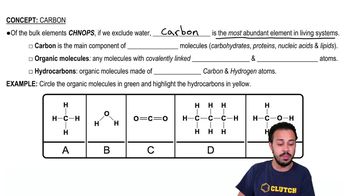
Hydrocarbons are molecules of only carbon and hydrogen, hydrophobic, found in fats, and store large amounts of energy.
Isomers have the same molecular formula but different structures and properties. Types: structural isomers, cis-trans isomers, and enantiomers.
Structural isomers differ in covalent atom arrangements; cis-trans isomers differ in spatial arrangement around a double bond due to restricted rotation.
Enantiomers are nonsuperimposable mirror images differing in 3D arrangement around a chiral carbon; often only one form is biologically active.
Acids increase H⁺ concentration; bases reduce it. Changes in pH affect molecular charge, protein shape, enzyme activity, and cell function.
pH measures H⁺ concentration: acidic <7, neutral = 7, basic >7. Most biological fluids maintain pH near 6–8 for proper function.
Buffers reversibly bind or release H⁺ ions, resisting large pH changes and protecting proteins and cells.
Functional groups are specific atom groupings that determine molecule behavior, including acidity, reactivity, and water interaction.
Hydroxyl, carbonyl, carboxyl, amino, sulfhydryl, phosphate, and methyl groups.
Macromolecules are polymers made of repeating monomers; monomers can also have individual functions.
Carbohydrates, proteins, nucleic acids, and lipids (lipids are not true polymers).
Simple sugars with formulas usually multiples of CH2O, classified by carbon number (tri-, pent-, hexoses) and carbonyl group position (aldose or ketose).
A covalent bond joining two monosaccharides to form disaccharides or polysaccharides, with α or β orientations affecting structure.
Starch and glycogen store energy with α-glycosidic bonds; cellulose provides structural support with β-1,4 glycosidic bonds forming fibrous chains.
Lipids are hydrophobic molecules including fats, phospholipids, and steroids; roles include energy storage, membrane structure, and signaling.
Fats consist of glycerol linked to three fatty acids by ester linkages, primarily for long-term energy storage and insulation.
Saturated fatty acids have no double bonds and max hydrogens; unsaturated have one or more double bonds causing kinks.
Phospholipids have hydrophilic heads and two hydrophobic tails, forming bilayers that create cell membranes with selective permeability.
Steroids have four fused carbon rings; cholesterol is key for membrane fluidity and precursor for hormones.
Amino acids have a central carbon bonded to an amino group, carboxyl group, hydrogen, and variable R group.
Amino acids join by peptide bonds formed through dehydration reactions, creating polypeptide chains with N- and C-termini.
Primary (amino acid sequence), secondary (α helix and β sheet), tertiary (3D folding), and quaternary (multiple polypeptide interactions).
A single amino acid substitution in hemoglobin alters red blood cell shape, causing blockages in blood vessels.
Changes in pH, salt concentration, temperature, or environment can unfold proteins, causing loss of function.
Polymers of nucleotides (DNA and RNA) that store, transmit, and express hereditary information.
A nitrogenous base, a pentose sugar (ribose or deoxyribose), and one or more phosphate groups.
By phosphodiester linkages between the 5′ phosphate and 3′ hydroxyl groups, giving strand directionality.