What is the primary function of the cell membrane?
The cell membrane regulates exchanges between the cell and its environment, controlling inbound and outbound traffic.
Describe the fluid mosaic model of the cell membrane.
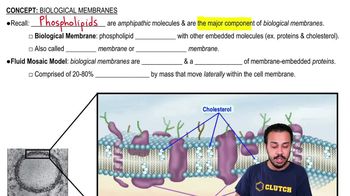
The fluid mosaic model depicts the membrane as a fluid phospholipid bilayer with embedded proteins that move laterally.
What are the main components of a phospholipid molecule?
A phospholipid has a hydrophilic head (choline, phosphate, glycerol) and two hydrophobic fatty acid tails.
Why are phospholipids described as amphipathic?
Phospholipids have both hydrophilic (water-attracting) heads and hydrophobic (water-repelling) tails.
What types of molecules can easily diffuse across the plasma membrane?
Small, nonpolar molecules like O2, CO2, and small polar molecules like H2O can diffuse easily.
Why do large polar molecules have difficulty crossing the membrane?
Large polar molecules like glucose and ions cannot easily cross due to the hydrophobic core of the membrane.
What is osmosis?
Osmosis is the diffusion of water across a selectively permeable membrane from low to high solute concentration.
How does a hypotonic solution affect animal and plant cells?
Animal cells may lyse (burst), while plant cells become turgid (normal) due to water intake.
What is the role of transport proteins in the membrane?
Transport proteins facilitate the movement of molecules that cannot diffuse freely, via passive or active transport.
What distinguishes active transport from passive transport?
Active transport requires energy (ATP) to move molecules against their concentration gradient; passive transport does not.
What is the significance of cholesterol in the plasma membrane?
Cholesterol modulates membrane fluidity and stability in animal cell membranes.
Describe the difference between Gram-positive and Gram-negative bacterial cell walls.
Gram-positive bacteria have a thick peptidoglycan layer with lipoteichoic acids; Gram-negative bacteria have a thin peptidoglycan layer and an outer membrane with lipopolysaccharides.
What is the S-layer in archaeal cells?
The S-layer is a proteinaceous cell wall layer found in archaea, providing structural support outside the cytoplasmic membrane.
What is the function of perforin used by cytotoxic T lymphocytes (CTLs)?
Perforin forms pores in target cell membranes to enable entry of granzymes, leading to cell death.
How do phagocytes use perforin-2 differently from CTLs?
Phagocytes use perforin-2 to target and kill microbes inside phagosomes, unlike CTLs which target infected or cancerous cells.
What is the significance of the phospholipid bilayer thickness and pore size in membrane proteins?
Membrane proteins have hydrophobic regions matching bilayer thickness; pores allow selective passage of molecules.
What is the role of vesicles in membrane transport?
Vesicles mediate bulk transport via endocytosis (inward) and exocytosis (outward) of large molecules.
What is the difference between simple diffusion and facilitated diffusion?
Simple diffusion occurs directly through the membrane; facilitated diffusion requires transport proteins.
How does the plasma membrane contribute to cell signaling?
Membrane proteins receive signals from outside, triggering intracellular responses and communication.
What is the role of glycolipids and glycoproteins in the membrane?
They contribute to cell recognition, signaling, and membrane stability on the extracellular side.
 뒤로
뒤로
 02:21
02:21