 뒤로
뒤로General Biology: Cells, Life, and Metabolism

 01:35
01:35

이 집합의 용어 (20)
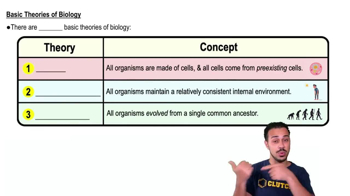
The cell is the fundamental building block of living organisms.
The three domains of life are Archaea, Bacteria, and Eukarya.
Eukarya have cells with organelles, are often multicellular, have larger cell size, and distinct ribosomal sequences.
Abiogenesis is the natural process by which life arises from non-living matter.
Cells are small because of the geometric relationship between surface area and volume, which affects nutrient exchange efficiency.
Life is based on carbon-based molecules and water, which form the chemical foundation of living cells.
An element is a pure substance that cannot be broken down into simpler substances by chemical reactions.
A molecule is multiple atoms bound together via covalent bonds.
The total energy of a closed system is constant; energy can be transferred or transformed but not created or destroyed.
Every energy transfer or transformation increases the entropy (disorder) of the universe.
Metabolism is the totality of an organism's chemical reactions.
Metabolic pathways are series of enzymatic steps that alter molecules to produce products, including catabolic and anabolic pathways.
Exergonic reactions release energy (ΔG < 0), while endergonic reactions require energy input (ΔG > 0).
An enzyme is a protein that acts as a catalyst to speed up chemical reactions without being consumed.
Enzymes lower Ea by orienting substrates, stretching bonds, providing favorable microenvironments, and participating in reactions.
Adenosine triphosphate (ATP) stores and transfers energy in cells, driving most coupled reactions via hydrolysis.
Ribosome subunits are assembled in the nucleolus and pass through nuclear pores in the nuclear membrane to the cytoplasm.
Centrosomes are organelles unique to animal cells, composed of structures called centrioles, important for cell division.
Resolution is limited by the wavelength of visible light, restricting the smallest structures that can be seen.
Most eukaryotic cells measure roughly 10 to 100 μm across their length.