 뒤로
뒤로General Biology: Chapter 1 & 2 Key Concepts
 02:09
02:09

이 집합의 용어 (25)
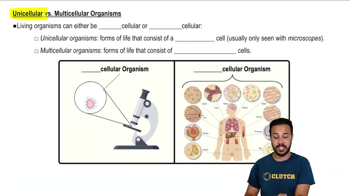
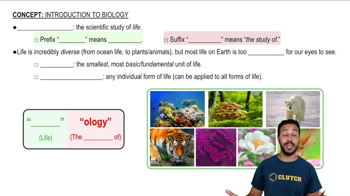
Biology is the scientific study of life, encompassing the properties and processes common to all living organisms.
Reproduction, Adaptation & Evolution, Response to Environment, Energy Usage, Homeostasis, Organization into cells, Growth & Development.
Viruses do not reproduce on their own, lack cellular organization, and do not carry out metabolism independently.
Bacteria and Archaea (simple cells), and Eukarya (includes protists, fungi, plants, and animals).
New properties that arise at each level of biological organization due to the arrangement and interactions of parts.
A tentative scientific explanation that can be tested through experiments or observations.
A scientific theory is a broad, well-tested explanation supported by a large body of evidence, unlike a hypothesis which is a tentative idea.
The independent variable is manipulated by the researcher; the dependent variable is the measured outcome affected by the independent variable.
Control groups serve as a baseline without the experimental treatment, while experimental groups receive the treatment to test its effect.
They analyze genetic similarities and differences without manipulating variables, thus are observational rather than experimental.
Evolution is the core theme explaining the unity and diversity of life through change over time.
Individuals with advantageous traits are more likely to survive and reproduce, passing those traits to offspring.
Humans selectively breed plants and animals (artificial selection) and also influence natural selection through environmental changes.
Biological structures are shaped to perform specific functions, from molecules to organs.
Energy enters as sunlight, is converted by producers to chemical energy, passed to consumers, and exits as heat.
The regulation of internal conditions to maintain a stable, constant environment within an organism.
Matter is anything that takes up space and has mass; elements are pure substances consisting of one type of atom essential for life.
Atoms of the same element with the same number of protons but different numbers of neutrons.
A chemical bond where atoms share one or more pairs of electrons.
Because of the unequal sharing of electrons between oxygen and hydrogen, creating partial positive and negative charges.
Attraction between oppositely charged ions formed by the transfer of electrons.
The tendency of water molecules to stick to each other due to hydrogen bonding.
Ice is less dense than liquid water because hydrogen bonds hold molecules in a stable, spaced lattice.
A measure of how acidic or basic a solution is, based on the concentration of hydrogen ions (H+).
Increased CO2 lowers ocean pH, reducing carbonate ions needed for coral skeleton formation, slowing coral growth.