 뒤로
뒤로General Biology: Chemical Basis of Life
 02:13
02:13
이 집합의 용어 (20)
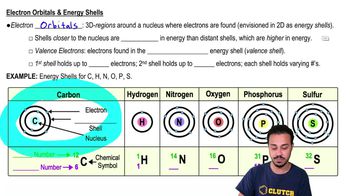
Atoms consist of a nucleus containing protons (positive charge) and neutrons (neutral), surrounded by electrons (negative charge).
The number of protons in an atom's nucleus, written as a subscript to the left of the element symbol.
The sum of protons and neutrons in an atom's nucleus.
Atoms of the same element with different numbers of neutrons, e.g., Carbon-12, Carbon-13, Carbon-14.
The average mass of all naturally occurring isotopes of an element, weighted by abundance.
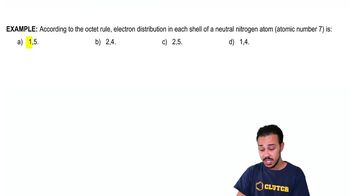
Electrons occupy orbitals grouped into shells; the outermost shell is the valence shell containing valence electrons important for bonding.
A chemical bond formed when two atoms share unpaired valence electrons, creating a stable molecule.
Nonpolar covalent bonds share electrons equally; polar covalent bonds share electrons unequally, creating partial charges.
Electronegativity increases up and to the right on the periodic table (O > N > S, C, H, P).
Bond formed by complete transfer of electrons from one atom to another, creating ions.
Cation: positively charged ion (loses electron). Anion: negatively charged ion (gains electron).
Shapes affect molecule behavior: methane is tetrahedral, water is bent, carbon dioxide is linear.
Water is small, bent, and highly polar due to polar covalent bonds; oxygen has partial negative charge, hydrogens partial positive.
Water molecules form hydrogen bonds with each other and with polar solutes, enabling solvent properties.
Hydrophilic molecules dissolve in water due to polarity; hydrophobic molecules are nonpolar and cluster together, avoiding water.
Cohesion: attraction between water molecules; adhesion: attraction to other substances; surface tension: cohesive force at water's surface.
Water is denser as a liquid than as a solid because ice has an open crystal structure, causing ice to float.
Water has a high specific heat due to hydrogen bonding, requiring much energy to change temperature.
Acids donate protons (increase H+), bases accept protons (decrease H+), and buffers minimize pH changes.
Measures hydrogen ion concentration: acidic < 7, neutral = 7, basic > 7; scale is logarithmic.