 뒤로
뒤로General Biology: Chemical Context of Life
 02:13
02:13
이 집합의 용어 (20)
Matter is anything that takes up space (volume) and has mass (can be weighed).
Elements are pure substances made of one type of atom. Compounds are substances formed by chemical combinations of two or more elements.
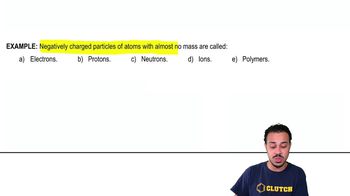
Protons (positive charge, mass 1 amu), neutrons (no charge, mass 1 amu), and electrons (negative charge, negligible mass).
The atomic number is the number of protons. The atomic mass is the sum of protons and neutrons in the nucleus.
Isotopes are variants of an element with the same number of protons but different numbers of neutrons.
A radioactive isotope decays spontaneously, releasing energy and particles.
They are used to date organic matter and trace biological processes.
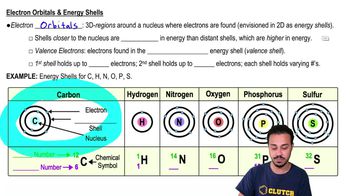
Orbitals are regions where electrons are found 90% of the time. Orbitals are grouped into electron shells with increasing energy farther from the nucleus.
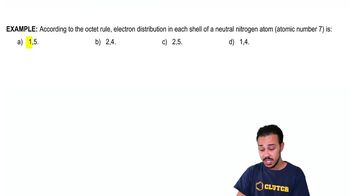
Shell capacity = \(2n^2\), where n is the shell number.
The valence shell is the outermost electron shell and determines an atom's chemical behavior.
A covalent bond involves the sharing of a pair of electrons between two atoms.
Electronegativity, the tendency of an atom to attract electrons, determines if a covalent bond is polar or nonpolar.
ΔEN between 0.4 and 1.8 indicates a polar covalent bond.
A polar molecule has partial positive and negative charges at different ends (dipole) due to unequal electron sharing.
An ionic bond involves the transfer of electrons from one atom to another, creating oppositely charged ions.
Hydrogen bonds are weak interactions between a hydrogen atom bonded to a highly electronegative atom and another electronegative atom.
Van der Waals interactions are weak, distance-dependent forces arising from temporary electron cloud fluctuations.
Water has a bent shape due to lone electron pairs on oxygen, causing unequal sharing of electrons and a dipole moment.
Electronegativity generally increases from left to right across a period and decreases down a group.
Polar covalent bonds have unequal electron sharing; nonpolar covalent bonds have equal sharing.