Skip to main content
General Biology
나의 코스
배우기
시험 준비
AI 튜터
학습 가이드
교과서적 해결책
플래시카드
탐험해 보세요
앱을 사용해 보세요
나의 코스
배우기
시험 준비
AI 튜터
학습 가이드
교과서적 해결책
플래시카드
탐험해 보세요
앱을 사용해 보세요
뒤로
General Biology: DNA, RNA, and Protein Synthesis
카드를 뒤집기 위해 탭할 수 있습니다.
Griffith's experiment
카드를 뒤집기 위해 탭할 수 있습니다.
👆
Griffith's experiment
Showed that a 'transforming principle' from dead bacteria could genetically change living bacteria, suggesting DNA carries genetic information.
진행 상황 추적
컨트롤 버튼이 '내비게이션' 모드로 변경되었습니다.
1/30
추천 영상
08:56
The Griffith Experiment
17753
views
261
rank
이 집합의 용어 (30)
하이드의 정의
Griffith's experiment
Showed that a 'transforming principle' from dead bacteria could genetically change living bacteria, suggesting DNA carries genetic information.
Hershey and Chase experiment
Used bacteriophages to prove DNA, not protein, is the genetic material by tracking radioactive labels in DNA and protein.
Structure of DNA
DNA is a double helix with a sugar-phosphate backbone and nitrogenous bases (A, T, C, G) paired by hydrogen bonds.
Structure of RNA
Single-stranded nucleic acid with ribose sugar and bases A, U, C, G; uracil replaces thymine found in DNA.
DNA replication process
DNA unwinds, and DNA polymerase adds complementary nucleotides to each strand following the semiconservative model.
Semiconservative model
Each new DNA molecule consists of one original strand and one newly synthesized strand.
Role of DNA polymerase
Enzyme that adds nucleotides to a growing DNA strand during replication and proofreads for errors.
Function of DNA ligase
Joins Okazaki fragments on the lagging strand to create a continuous DNA strand.
Transcription location and products
Occurs in the nucleus; produces messenger RNA (mRNA) from a DNA template.
Translation location and products
Occurs in the cytoplasm at ribosomes; produces polypeptides (proteins) from mRNA.
Genetic code
Set of rules by which nucleotide triplets (codons) in mRNA specify amino acids in proteins.
Codon
A sequence of three nucleotides in mRNA that codes for a specific amino acid or stop signal.
Anticodon
A three-nucleotide sequence on tRNA complementary to an mRNA codon.
mRNA processing in eukaryotes
Includes 5' capping, poly-A tail addition, and RNA splicing to remove introns before export from the nucleus.
RNA splicing
Removal of non-coding introns from pre-mRNA and joining of exons to form mature mRNA.
Structure and function of tRNA
tRNA has an anticodon region and an amino acid attachment site; it delivers amino acids during translation.
Ribosome structure and function
Composed of rRNA and proteins; facilitates the binding of tRNA and mRNA to synthesize polypeptides.
Start codon
The codon AUG signals the start of translation and codes for methionine.
Stop codons
Codons UAA, UAG, and UGA signal termination of translation.
Frameshift mutation
Mutation caused by insertions or deletions that shift the reading frame, altering downstream amino acid sequence.
Missense mutation
A nucleotide change that results in a different amino acid in the protein.
Nonsense mutation
A mutation that changes a codon to a stop codon, prematurely terminating translation.
Silent mutation
A nucleotide change that does not alter the amino acid sequence due to genetic code redundancy.
Mutagen
An agent, such as radiation or chemicals, that causes mutations in DNA.
Sugar-phosphate backbone
The repeating chain of sugar and phosphate groups forming the structural framework of DNA and RNA strands.
Triplet code
The three-nucleotide sequence in DNA or RNA that corresponds to one amino acid.
Phage
A virus that infects bacteria, used in experiments to study genetic material.
Promoter
A DNA sequence where RNA polymerase binds to initiate transcription.
Terminator
A DNA sequence signaling the end of transcription.
Reverse transcriptase
An enzyme that synthesizes DNA from an RNA template, used by retroviruses.
 뒤로뒤로
뒤로뒤로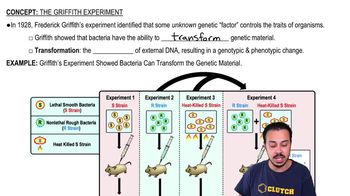
 08:56
08:56