 뒤로
뒤로General Biology: Evolution
 03:22
03:22
이 집합의 용어 (20)
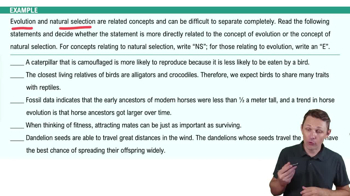
Evolution is the change in the heritable characteristics of biological populations over successive generations.
Charles Darwin is known as the father of evolution for his theory of natural selection.
Natural selection is the process where organisms better adapted to their environment tend to survive and produce more offspring.
A mutation is a change in the DNA sequence that can introduce new genetic variation into a population.
Genetic drift is a random change in allele frequencies in a population, especially in small populations.
Gene flow is the transfer of genetic material between separate populations.
Speciation is the evolutionary process by which populations evolve to become distinct species.
Adaptation is a trait shaped by natural selection that increases an organism's reproductive success in its environment.
Microevolution refers to small evolutionary changes within a species, while macroevolution refers to larger changes that can result in new species.
Evidence includes fossil records, comparative anatomy, molecular biology, and biogeography.
Homologous structures are anatomical features in different species that originated from a common ancestor.
Analogous structures are features that serve similar functions but evolved independently in different species.
Fitness is an organism's ability to survive and reproduce, passing on its genes to the next generation.
The Hardy-Weinberg principle states that allele and genotype frequencies remain constant in a population if no evolutionary forces act on it.
No mutation, random mating, no gene flow, infinite population size, and no selection.
Sexual selection is a form of natural selection where certain traits increase an individual's chances of mating.
The bottleneck effect is a sharp reduction in population size leading to decreased genetic diversity.
The founder effect occurs when a new population is established by a small number of individuals, reducing genetic variation.
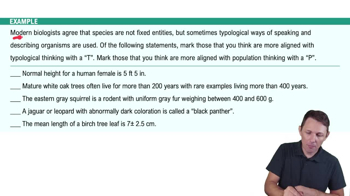
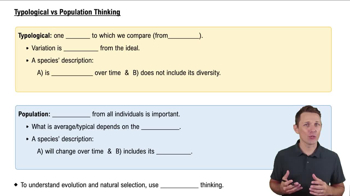
Evolutionary changes occur in populations over generations, as allele frequencies shift; individuals do not evolve.
Coevolution is the reciprocal evolutionary change between interacting species.