 뒤로
뒤로General Biology: Evolution and Natural Selection
 07:48
07:48
이 집합의 용어 (24)
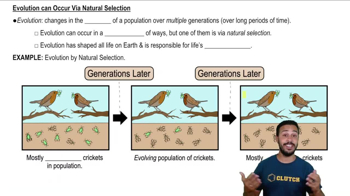
Change in allele frequencies in a population over generations.
Organisms are related through common ancestry and accumulate differences as they adapt to environments over time.
Populations evolve over generations; individuals do not evolve.
Published The Origin of Species, proposing species descend from ancestral species through natural selection.
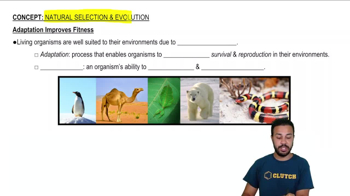
An inherited characteristic that enhances survival and reproduction in a specific environment.
Proposed use and disuse and inheritance of acquired characteristics, which is not supported by evidence.
Lamarck: acquired traits passed on; Darwin: inherited variation + differential survival and reproduction.
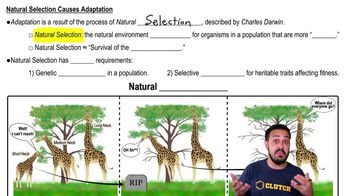
Members of a population vary in their inherited traits.
Species produce more offspring than the environment can support, causing many to fail to survive and reproduce.
Process where individuals with certain inherited traits survive and reproduce at higher rates, increasing trait frequency.
No, it selects among traits already present in the population.
Natural selection, genetic drift, and gene flow.
Random chance events that alter allele frequencies in a population.
Transfer of alleles between populations.
MRSA bacteria survive methicillin by using a resistant enzyme, increasing in frequency due to natural selection.
Similarity due to common ancestry, such as homologous structures with the same basic bone arrangement.
Reveals anatomical homologies in embryos, like post-anal tails and pharyngeal arches, not visible in adults.
Shared genes inherited from a common ancestor that may acquire new functions or lose function.
Independent evolution of similar traits in distantly related groups adapting to similar environments.
Documents extinction, origin of new groups, changes over time, and evolutionary transitions.
Study of species geographic distribution, influenced by continental drift and providing evidence for evolution.
Natural selection = trait advantage; Genetic drift = chance; Gene flow = allele movement between populations.
Individuals do not evolve; populations evolve through changes in allele frequencies.
Unequal survival and reproduction cause favorable traits to accumulate in populations over generations.