 뒤로
뒤로General Biology: Evolution, Life, and Chemical Context
 02:09
02:09

이 집합의 용어 (35)
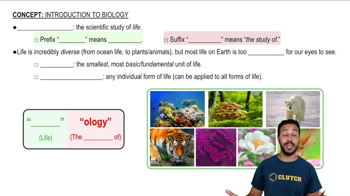
Biology is the scientific study of life.
Prefix "bio" means life. Suffix "-ology" means the study of.
Cell is the smallest, most basic/fundamental unit of life.
An organism is any individual form of life, applicable to all forms of life.
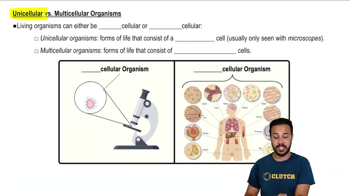
Unicellular organisms consist of a single cell. Multicellular organisms consist of many cells.
All living organisms share key characteristics such as organization, energy use, homeostasis, growth, reproduction, and evolution.
Homeostasis is the ability to maintain a stable internal environment despite external changes.
Atom → Molecule → Organelle → Cell → Tissue → Organ → Organ System → Organism → Population → Community → Ecosystem → Biosphere.
Emergent properties arise when smaller parts combine to form a whole with new functions not seen in individual parts.
Adaptation is a process that enables organisms to survive and reproduce better in their environment.
Natural selection is the process where the environment selects for organisms with traits that increase fitness, often called 'survival of the fittest.'
1) Genetic variation in a population. 2) Selective pressure favoring heritable traits that affect fitness.
Evolution is the change in the genetic makeup of a population over generations, often driven by natural selection.
Taxonomy is the branch of science that classifies, identifies, and names organisms.
Bacteria, Archaea (both prokaryotic), and Eukarya (eukaryotic organisms).
Kingdoms Animalia, Plantae, Fungi, and Protista.
Autotrophs (producers) make their own food, heterotrophs (consumers) eat other organisms, and decomposers obtain energy from dead matter.
A procedure to ask questions, test ideas, and build scientific knowledge through observation, hypothesis, experimentation, and analysis.
A proposed, testable explanation for an observation that includes a prediction.
A well-supported, testable explanation of many observations, supported by a large body of evidence.
A scientific investigation designed to test the validity of a hypothesis or theory.
Independent variable is the factor changed by the researcher. Dependent variable is the factor measured or observed.
False positive: incorrect indication of a result being present. False negative: incorrect indication of a result being absent.
Positive control: group expected to show a response. Negative control: group expected to show no response, used to prevent false results.
The smallest unit of an element, made of protons, neutrons, and electrons.
Protons (+), Neutrons (neutral), Electrons (-).
Atomic number = number of protons. Atomic mass = total number of protons and neutrons.
Atoms are most stable when their outer valence shell is full, usually with 8 electrons.
Atoms of the same element with different numbers of neutrons and different mass numbers.
Unstable isotopes that decay over time, emitting energy; used in medicine and dating fossils.
Attractive forces between atoms that hold them together to form molecules and compounds.
Intramolecular bonds occur within a molecule; intermolecular bonds occur between molecules.
Bonds formed by sharing electrons between atoms; can be polar (unequal sharing) or nonpolar (equal sharing).
Electrical attractions between oppositely charged ions formed by transfer of electrons.
Weak interactions between a hydrogen atom covalently bonded to an electronegative atom and another electronegative atom.