 뒤로
뒤로General Biology Exam 1 Key Concepts
 01:35
01:35
이 집합의 용어 (29)
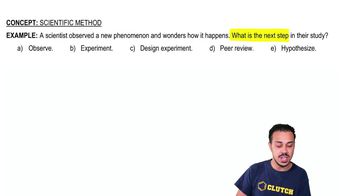
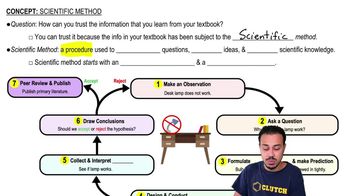
Includes observation, hypothesis formation, experimentation, data analysis, and conclusion.
Hypothesis: testable explanation; Prediction: expected outcome; Theory: well-supported broad explanation.
Experimental group: receives treatment; Control group: baseline for comparison, no treatment.
Independent variable: manipulated factor; Dependent variable: measured outcome.
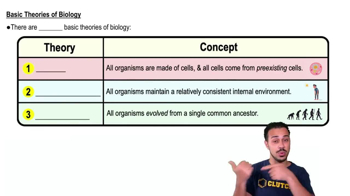
Species change over time, passing traits to offspring with variations.
Individuals with advantageous traits survive and reproduce more, increasing trait frequency.
Evolution, structure and function, information flow, energy transformations, and systems biology.
Order, regulation, growth, energy processing, response to environment, reproduction, and evolution.
Atom < molecule < organelle < cell < tissue < organ < organism < population < community < ecosystem < biosphere.
Protons (+), neutrons (0), electrons (-).
Required in small amounts; e.g., iodine prevents goiter.
Polar molecule enabling hydrogen bonding, solvent properties, and temperature regulation.
Result of hydrogen bonds creating a 'skin' on water surface.
Adhesion: water sticks to other surfaces; Cohesion: water molecules stick to each other.
Measures acidity/basicity; buffers resist pH changes.
Acids donate H+ ions; bases accept H+ ions.
Covalent: shared electrons; Ionic: transferred electrons; Hydrogen: weak attraction between polar molecules.
Can form four covalent bonds, creating diverse organic molecules.
Dehydration: builds polymers by removing water; Hydrolysis: breaks polymers by adding water.
Saturated: no double bonds, solid at room temp; Unsaturated: one or more double bonds, liquid at room temp.
Simple sugars, two sugars linked, and long sugar chains respectively.
Cellulose (structure), starch (energy storage in plants), glycogen (energy storage in animals).
DNA: double-stranded, deoxyribose sugar; RNA: single-stranded, ribose sugar.
A pairs with T (or U in RNA), C pairs with G.
Hydrophilic: water-attracting; hydrophobic: water-repelling.
Primary, secondary, tertiary, and quaternary structures determine shape and function.
Biological catalysts that speed up chemical reactions without being consumed.
Insufficient lactase enzyme to digest lactose sugar.
Natural selection favors bacteria with mutations that resist antibiotics.