Skip to main content
General Biology
나의 코스
배우기
시험 준비
AI 튜터
학습 가이드
교과서적 해결책
플래시카드
탐험해 보세요
앱을 사용해 보세요
나의 코스
배우기
시험 준비
AI 튜터
학습 가이드
교과서적 해결책
플래시카드
탐험해 보세요
앱을 사용해 보세요
뒤로
General Biology Exam 1 Study Flashcards
카드를 뒤집기 위해 탭할 수 있습니다.
Independent Variable
카드를 뒤집기 위해 탭할 수 있습니다.
👆
Independent Variable
The variable that is intentionally changed or manipulated by the experimenter.
진행 상황 추적
컨트롤 버튼이 '내비게이션' 모드로 변경되었습니다.
1/23
추천 영상
01:35
Scientific Method Example 1
12073
views
274
rank
03:03
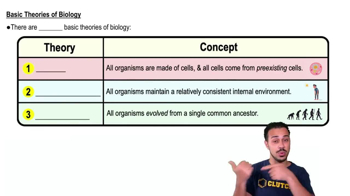
Basic Theories of Biology
12786
views
263
rank
1
comments
06:29
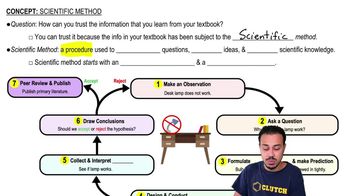
Scientific Method
20549
views
490
rank
1
comments
이 집합의 용어 (23)
하이드의 정의
Independent Variable
The variable that is intentionally changed or manipulated by the experimenter.
Dependent Variable
The variable that is measured or observed; the outcome response data.
Control Group
The experimental baseline group kept under standard conditions with no treatment applied.
Ionic Bond
A chemical bond formed via the complete transfer of electrons between atoms.
Covalent Bond
A stable chemical bond formed when two atoms share valence electrons.
Hydrogen Bond
A weak electrostatic attraction between a partially positive H atom and a partially negative atom.
Acidic Solution
A solution with a pH below 7 containing a high concentration of H+ ions.
Basic Solution
A solution with a pH above 7 containing a low concentration of H+ ions.
Logarithmic pH Scale
A scale where each whole unit change represents a 10-fold difference in H+ concentration.
Protein Monomer
Amino acids linked together by peptide bonds to form polypeptides.
Scientific Hypothesis
A testable and falsifiable statement predicting the outcome of an experiment.
Role of Control Group
Serves as a baseline to compare the effects of the treatment in an experiment.
Subatomic Particle with Negative Charge
Electron, which orbits the nucleus of an atom.
pH 3 vs pH 4 Acidity Difference
pH 3 is 10 times more acidic than pH 4.
pH 10 vs pH 8 Basicity Difference
pH 10 is 100 times more basic than pH 8.
Example of Acidic Substances
Stomach acid (pH 1.5-2.0) and lemons (pH 2.3).
Example of Basic Substances
Oven cleaner (pH 13.5) and ammonia (pH 11.7).
Type of Investigation in Light Exposure Experiment
Experimental, where the independent variable is manipulated and other factors are controlled.
Result of Light Exposure on Bean Plants
Plants exposed to natural sunlight grew taller, supporting the hypothesis.
Macromolecule: DNA and RNA
Nucleotide polymers.
Macromolecule: Protein
Amino acid polymer.
Macromolecule: Lipid
Hydrophobic hydrocarbons or fatty acids.
Macromolecule: Carbohydrate
Short-term energy storage molecules.
 뒤로뒤로
뒤로뒤로
 01:35
01:35