Skip to main content
General Biology
나의 코스
배우기
시험 준비
AI 튜터
학습 가이드
교과서적 해결책
플래시카드
탐험해 보세요
앱을 사용해 보세요
나의 코스
배우기
시험 준비
AI 튜터
학습 가이드
교과서적 해결책
플래시카드
탐험해 보세요
앱을 사용해 보세요
뒤로
General Biology Exam 1 Study Guide
카드를 뒤집기 위해 탭할 수 있습니다.
What are the four major unifying themes of biology?
카드를 뒤집기 위해 탭할 수 있습니다.
👆
What are the four major unifying themes of biology?
Organization
,
Information
,
Energy and Matter
, and
Interaction
.
진행 상황 추적
컨트롤 버튼이 '내비게이션' 모드로 변경되었습니다.
1/29
추천 영상
02:09
Unicellular vs. Multicellular
34522
views
1205
rank
2
comments
02:54
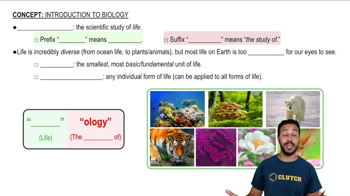
Introduction to Biology
54984
views
1953
rank
8
comments
1:28
Introduction to Biology Channel
64029
views
1582
rank
12
comments
이 집합의 용어 (29)
하이드의 정의
What are the four major unifying themes of biology?
Organization
,
Information
,
Energy and Matter
, and
Interaction
.
Define emergent properties in biology.
New properties that arise at each level of biological organization that are not present at lower levels.
List the levels of biological organization from molecule to ecosystem.
Molecule, organelle, cell, tissue, organ, organ system, organism, population, community, ecosystem.
What are the three domains of life and an example organism for each?
Bacteria
(e.g., Streptococcus),
Archaea
(e.g., extremophiles),
Eukarya
(e.g., humans).
What are the three conditions required for natural selection?
Variation in traits, heredity of traits, and differential reproductive success due to selective pressure.
Explain how natural selection works using the Florida Beach Mouse example.
Variation in coat color exists; coat color is heritable; light sand selects for light coat; light mice survive and reproduce more.
What is a scientific hypothesis?
A testable and falsifiable explanation for an observation or phenomenon.
Differentiate independent and dependent variables in an experiment.
Independent variable is manipulated; dependent variable is the measured outcome.
When is a bar graph appropriate?
For categorical data to compare different groups.
When is a line graph appropriate?
For continuous data to show trends over time or gradients.
Why must cells remain small?
To maintain a high surface area-to-volume ratio for efficient material exchange and communication.
What happens to surface area-to-volume ratio as cell size increases?
The ratio decreases, limiting efficient exchange and requiring cells to divide.
Name three basic features all cells have.
DNA, ribosomes, and plasma membrane.
Describe the main difference between prokaryotic and eukaryotic cells.
Prokaryotes lack membrane-bound organelles and nucleus; eukaryotes have both.
What structural difference distinguishes gram-positive from gram-negative bacteria?
Gram-positive have thick peptidoglycan cell walls; gram-negative have thin walls plus an outer membrane.
How do antibiotics like penicillin target bacteria but not human cells?
They target bacterial-specific structures like peptidoglycan cell walls absent in human cells.
List key organelles found in both plant and animal cells.
Nucleus, mitochondria, rough and smooth ER, Golgi apparatus, lysosomes, cytoskeleton.
What organelles are unique to plant cells?
Cell wall, chloroplasts, and large central vacuole.
Describe the role of the cytoskeleton.
Maintains cell shape, enables movement, and organizes organelles.
What is the endosymbiosis theory?
Eukaryotic cells evolved from prokaryotic cells engulfing others that became mitochondria and chloroplasts.
Name four pieces of evidence supporting the endosymbiosis theory.
Mitochondria and chloroplasts have their own DNA, double membranes, similar size to bacteria, and reproduce independently.
What organelle is abundant in white blood cells and why?
Lysosomes, for digesting bacteria and foreign invaders.
What organelles are abundant in muscle cells?
Actin for contraction and mitochondria for ATP production.
What organelle malfunction causes low ATP in cells?
Mitochondria malfunction.
What is the function of rough ER in protein synthesis?
Synthesizes proteins destined for secretion or membranes.
What is the function of smooth ER?
Lipid synthesis, detoxification, and calcium storage.
How does cytochalasin D affect cells?
Prevents actin polymerization, disrupting movement and division.
What is the correct pathway for insulin secretion?
Rough ER → transport vesicles → Golgi apparatus → transport vesicles → cell membrane.
Why do antibiotics reduce bacterial growth but not harm human cells?
They target bacterial-specific structures like cell walls and ribosomes different from human cells.
 뒤로뒤로
뒤로뒤로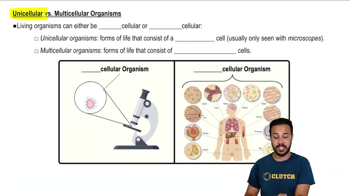
 02:09
02:09