Skip to main content
General Biology
나의 코스
배우기
시험 준비
AI 튜터
학습 가이드
교과서적 해결책
플래시카드
탐험해 보세요
앱을 사용해 보세요
나의 코스
배우기
시험 준비
AI 튜터
학습 가이드
교과서적 해결책
플래시카드
탐험해 보세요
앱을 사용해 보세요
뒤로
General Biology Exam #2 Review
카드를 뒤집기 위해 탭할 수 있습니다.
Which material is hydrophobic?
카드를 뒤집기 위해 탭할 수 있습니다.
👆
Which material is hydrophobic?
Oil
is hydrophobic, meaning it repels water.
진행 상황 추적
컨트롤 버튼이 '내비게이션' 모드로 변경되었습니다.
1/31
추천 영상
02:44
Diffusion
19166
views
306
rank
2
comments
04:51
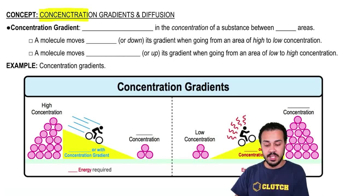
Concentration Gradients and Diffusion
40
views
1
rank
이 집합의 용어 (31)
하이드의 정의
Which material is hydrophobic?
Oil
is hydrophobic, meaning it repels water.
What types of bonds are hydrophilic?
Covalent polar bonds
and
ionic bonds
are hydrophilic, meaning they attract water.
What causes cohesion, adhesion, and surface tension in water?
Hydrogen bonds
between water molecules cause these properties.
What happens during evaporative cooling on a hot day with low humidity?
Water evaporates faster from the skin, helping to
cool the skin
.
What does a pH of 13 in a 0.57 M solution indicate?
The substance is a
strong base
that dissociates completely in water.
If pH decreases from 12 to 10, what changes occur?
The concentration of
H+
ions increases by
one hundred-fold (100x)
.
What is the pH when H+ and OH- concentrations are equal?
The pH is
neutral
.
What is ocean acidification?
Increased CO2 forms carbonic acid, releasing H+ that reduces carbonate ions, softening shells and coral.
Which physical property is important for a car coolant?
Specific heat
capacity is key to absorb a great deal of heat.
Why does ice float on liquid water?
Stable
hydrogen bonds
keep ice molecules farther apart, making ice less dense.
What type of bonds hold hydrogen and oxygen in a water molecule?
Polar covalent bonds
connect the atoms within a water molecule.
Three major differences between DNA and RNA?
DNA has
deoxyribose
, uses
thymine
, and is
double-stranded
; RNA has
ribose
, uses
uracil
, and is
single-stranded
.
What type of lipid is found in cell membranes?
Phospholipids
with hydrophilic heads and hydrophobic tails form membranes.
Difference between hydrophobic and hydrophilic substances?
Hydrophilic substances are
polar
; hydrophobic substances are
nonpolar
.
Relationship between dehydration reactions and hydrolysis?
Dehydration reactions
assemble polymers
; hydrolysis reactions
break polymers apart
.
Which polysaccharide is important in animals and fungi structure?
Chitin
is a structural polysaccharide in animals and fungi.
Is lactose a monosaccharide, disaccharide, or polysaccharide?
Lactose is a
disaccharide
.
Difference between saturated and unsaturated fatty acids?
Saturated fatty acids have
no double bonds
and are solid; unsaturated have
one or more double bonds
and are liquid at room temperature.
What part of an amino acid gives it its distinct character?
The
R group (side chain)
determines amino acid properties.
Which molecules pass most easily through cell membranes?
Small and hydrophobic
molecules pass most easily.
Match bond types to macromolecules: peptide, glycosidic, ester, phosphodiester.
Peptide bond → protein; Glycosidic bond → carbohydrate; Ester linkage → lipid; Phosphodiester bond → nucleic acid.
Which is not a polymer: glucose, starch, RNA, DNA?
Glucose
is a monomer, not a polymer.
Monomers of carbohydrates are?
Monosaccharides
are carbohydrate monomers.
Unsaturated and saturated refer to which lipid part?
They refer to the
fatty acids
.
Protein structural level least affected by hydrogen bond disruption?
The
primary level
is least affected.
Central dogma of molecular biology?
DNA is
transcribed into RNA
, which is
translated into protein
.
Where is uracil (U) and thymine (T) found?
Uracil is in
RNA
; thymine is in
DNA
.
Force driving simple diffusion and energy source for active transport?
Simple diffusion is driven by the
concentration gradient
; active transport uses
ATP
.
What process do white blood cells use to engulf bacteria?
Phagocytosis
is used by white blood cells.
Why does carbon have a valency of 4?
Carbon has 4 electrons in its outer shell available to
form covalent bonds
.
In the cell and solution with 90% water inside and 70% outside, which way does water move?
Water moves
out of the cell
by osmosis due to higher water concentration inside.
 뒤로뒤로
뒤로뒤로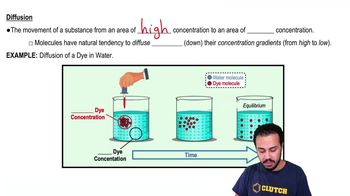
 02:44
02:44