Skip to main content
General Biology
나의 코스
배우기
시험 준비
AI 튜터
학습 가이드
교과서적 해결책
플래시카드
탐험해 보세요
앱을 사용해 보세요
나의 코스
배우기
시험 준비
AI 튜터
학습 가이드
교과서적 해결책
플래시카드
탐험해 보세요
앱을 사용해 보세요
뒤로
General Biology Exam #2 Review Flashcards
카드를 뒤집기 위해 탭할 수 있습니다.
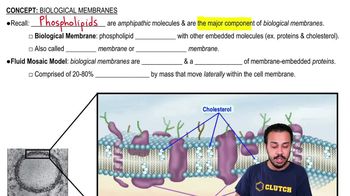
Why do phospholipids spontaneously form membranes when mixed with water?
카드를 뒤집기 위해 탭할 수 있습니다.
👆
Why do phospholipids spontaneously form membranes when mixed with water?
Because they are
amphipathic
, having both hydrophilic heads and hydrophobic tails, which causes them to arrange into bilayers.
진행 상황 추적
컨트롤 버튼이 '내비게이션' 모드로 변경되었습니다.
1/43
추천 영상
02:21
Biological Membranes Example 1
20690
views
371
rank
1
comments
06:04
Biological Membranes
28347
views
530
rank
2
comments
이 집합의 용어 (43)
하이드의 정의
Why do phospholipids spontaneously form membranes when mixed with water?
Because they are
amphipathic
, having both hydrophilic heads and hydrophobic tails, which causes them to arrange into bilayers.
What stores the information necessary to produce proteins?
DNA
stores the genetic information for protein synthesis.
Where does protein synthesis take place?
Protein synthesis takes place at the
ribosomes
.
What hormone is secreted from the cell that is manufactured by ribosomes?
Proteins made by ribosomes can include
protein hormones
that are secreted by the cell.
What theory states that all living things are composed of cells?
The
Cell Theory
states that all living things are composed of cells.
Differences between eukaryotic and prokaryotic cells?
Eukaryotic cells have a
nucleus
and membrane-bound organelles; prokaryotic cells do not.
What type of cell has both a nucleus and a cell wall?
Plant cells
have both a nucleus and a cell wall.
Differences between animal and plant cells?
Plant cells have a
cell wall
, chloroplasts, and large central vacuoles; animal cells do not.
Function of the cell plasma membrane?
The plasma membrane controls
selective transport
of substances in and out of the cell.
Major lipids of cell plasma membranes?
Phospholipids
are the major lipids forming the plasma membrane bilayer.
What structures move proteins from the rough ER to the Golgi apparatus?
Vesicles
transport proteins from the rough ER to the Golgi apparatus.
Function of the Golgi apparatus?
The Golgi apparatus
modifies, sorts, and packages
proteins for secretion or delivery.
Which cell part is most like the shipping center of a company?
The
Golgi apparatus
functions like the shipping center.
Function of lysosomes?
Lysosomes contain enzymes that
digest and recycle
cellular waste and foreign material.
Which protist contains contractile vacuoles?
Freshwater protists
like Paramecium have contractile vacuoles to expel excess water.
What characterizes plant cells unlike animal cells?
Plant cells have a
cell wall, chloroplasts,
and a large central vacuole.
Which organelle is responsible for photosynthesis?
The
chloroplast
is responsible for photosynthesis.
How can cellular respiration be described?
Cellular respiration converts
chemical energy in glucose
into usable energy (ATP).
What hairlike structures allow Paramecium to move?
Cilia
are hairlike structures that enable Paramecium to swim.
What is energy?
Energy is the
capacity to do work or cause change
.
What type of energy is energy of motion?
Kinetic energy
is the energy of motion.
What type of energy does a rock on top of a mountain have?
It has
potential energy
due to its position.
What compound directly provides energy for cellular work?
ATP (adenosine triphosphate)
directly provides energy for cellular work.
How is energy transferred from ATP to other molecules?
Energy is transferred by transferring a
phosphate group
from ATP.
What is the sum of all chemical reactions in organisms called?
The sum of all chemical reactions is called
metabolism
.
What is the result of glycolysis?
Glycolysis breaks glucose into
pyruvate, producing ATP and NADH
.
What waste products do yeast produce under anaerobic conditions?
Yeast produce
ethanol and carbon dioxide
during anaerobic fermentation.
Where do cellular respiration processes take place?
Glycolysis occurs in the
cytoplasm
, and the Krebs cycle and electron transport occur in the
mitochondria
.
How do enzymes increase the rate of a reaction?
Enzymes lower the
activation energy
needed for a reaction.
What is the region of an enzyme where a substrate binds?
The substrate binds at the enzyme's
active site
.
Define osmosis.
Osmosis is the diffusion of
water across a selectively permeable membrane
.
What is diffusion?
Diffusion is the movement of molecules from an area of
higher to lower concentration
.
What happens to a cell in an isotonic solution?
The cell neither gains nor loses water; it is in
equilibrium
.
What happens to a plant cell in a hypotonic solution?
The plant cell
swells
as water enters, becoming turgid.
What is active transport?
Active transport moves substances
against their concentration gradient
using energy (ATP).
What is the process called when a white blood cell engulfs a bacterium?
This process is called
phagocytosis
.
What are photosynthetic organisms?
Organisms that convert light energy into chemical energy via
photosynthesis
.
What are the waste products of cellular respiration?
The waste products are
carbon dioxide and water
.
How does photosynthesis contribute to plant growth?
Photosynthesis produces
glucose
, which is used to build plant biomass.
Through what structures do plants obtain most of their water?
Plants absorb water mainly through their
roots
.
What is the equation of photosynthesis?
6 CO
2
+ 6 H
2
O + light energy → C
6
H
12
O
6
+ 6 O
2
What do the light reactions of photosynthesis convert?
They convert
light energy
to
chemical energy
(ATP and NADPH).
What are the products of the light reactions of photosynthesis?
The products are
ATP, NADPH, and oxygen
.
 뒤로뒤로
뒤로뒤로
 02:21
02:21