 뒤로
뒤로General Biology Final Exam Review Flashcards
 09:26
09:26
이 집합의 용어 (36)
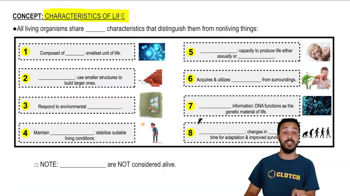
Living things exhibit organization, metabolism, homeostasis, growth, reproduction, response to stimuli, and evolution.
From smallest to largest: molecule, cell, tissue, organ, organ system, organism, population, community, ecosystem, biosphere.
Prokaryotes lack a nucleus and membrane-bound organelles; eukaryotes have a nucleus and organelles.
Bacteria, Archaea (both prokaryotes), and Eukarya (eukaryotes).
A hypothesis is a testable prediction; a theory is a well-supported explanation based on evidence.
Positive feedback amplifies a response; negative feedback reduces a response to maintain homeostasis.
Protons (+) and neutrons (neutral) in nucleus; electrons (-) orbit in shells.
Atomic number = number of protons; atomic mass ≈ protons + neutrons.
Valence electrons determine chemical reactivity and bonding.
Covalent bonds share electrons; ionic bonds transfer electrons; hydrogen bonds are weak attractions between polar molecules.
Difference in electronegativity causes polar covalent or nonpolar covalent bonds; large difference forms ionic bonds.
Water has hydrogen bonds, cohesion, adhesion, surface tension, and high specific heat.
Solvent dissolves substances; solute is dissolved.
Hydrophobic molecules repel water; hydrophilic molecules attract water.
Acids donate H+; bases accept H+; buffers stabilize pH.
Carbon forms four covalent bonds, allowing diverse organic molecules.
Compounds with same formula but different structures: structural, cis-trans, and enantiomers.
Dehydration synthesis builds polymers by removing water; hydrolysis breaks polymers by adding water.
Monosaccharides (simple sugars), disaccharides, and polysaccharides (complex carbs).
Fats store energy; phospholipids form membranes; steroids have ring structures.
Proteins are polymers of amino acids with four levels of structure: primary to quaternary.
RNA is single-stranded, contains ribose and uracil; DNA is double-stranded, contains deoxyribose and thymine.
Examples: nucleus stores DNA, mitochondria produce ATP, ribosomes synthesize proteins.
Phospholipid bilayer with embedded proteins, cholesterol, and carbohydrates.
Diffusion is movement of molecules from high to low concentration; osmosis is diffusion of water across a membrane.
Hypertonic: cell loses water; isotonic: no net water movement; hypotonic: cell gains water.
ATP stores and transfers energy for cellular processes.
Enzymes lower activation energy; denaturation alters their shape and function.
Oxidation is loss of electrons; reduction is gain of electrons.
Glycolysis in cytoplasm; citric acid cycle and electron transport chain in mitochondria.
Light reactions in thylakoid membranes; Calvin cycle in stroma of chloroplasts.
Prophase, metaphase, anaphase, telophase; followed by cytokinesis.
Mitosis produces two identical diploid cells; meiosis produces four genetically diverse haploid cells.
Law of segregation and law of independent assortment.
Semiconservative, involves leading and lagging strands, Okazaki fragments, and enzymes like DNA polymerase.
Transcription copies DNA to RNA; translation synthesizes protein from mRNA.