 뒤로
뒤로General Biology: Fundamentals of Life and Biomolecules
 09:26
09:26
이 집합의 용어 (20)
Life is a self-sustained chemical system capable of undergoing Darwinian evolution.
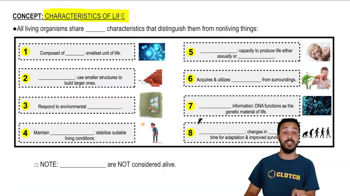
Life is membrane delimited, made of cells, stores and follows instructions, stores and uses energy, is self-replicating, controls functions and responds to the environment, and evolves.
Lipids provide selectively permeable membranes for compartmentation, act as energy sources, and provide insulation.
The four main biomolecules are lipids, carbohydrates, nucleic acids, and proteins.
Nucleic acids store and transmit genetic information essential for life.
Membranes made of lipids create compartments that separate the cell from its environment and regulate material exchange.
Energy from sunlight or organic compounds is converted into ATP, which cells use to perform work.
Proteins control cellular functions and enable responses to environmental changes.
Evolution is the change in heritable characteristics of biological populations over successive generations.
The cell is the smallest unit that exhibits all properties of life.
Prokaryotes lack a nucleus and membrane-bound organelles; eukaryotes have a nucleus and organelles.
Prokaryotes have circular DNA, no nucleus, small size (0.1-5 microns), and often lack membrane-bound organelles.
Eukaryotes have linear DNA organized in chromosomes, a nucleus, membrane-bound organelles, and larger size (1-100 microns).
Viruses store and follow instructions, use energy, replicate, respond, and evolve but lack membranes and do not store energy independently.
Monosaccharides are carbohydrate monomers; polymers include disaccharides and polysaccharides like glycogen.
Amino acids are protein monomers that link via peptide bonds to form proteins.
A phospholipid has a hydrophilic phosphate head and two hydrophobic fatty acid tails, forming cell membranes.
Adenine pairs with Thymine, and Cytosine pairs with Guanine via hydrogen bonds.
Information flows from DNA to mRNA to tRNA to protein.
ATP is the main energy currency used by cells to perform work.