Skip to main content
General Biology
나의 코스
배우기
시험 준비
AI 튜터
학습 가이드
교과서적 해결책
플래시카드
탐험해 보세요
앱을 사용해 보세요
나의 코스
배우기
시험 준비
AI 튜터
학습 가이드
교과서적 해결책
플래시카드
탐험해 보세요
앱을 사용해 보세요
뒤로
General Biology: Genetics and Cell Biology Flashcards
카드를 뒤집기 위해 탭할 수 있습니다.
Result of crossing true-breeding purple-flowered and white-flowered pea plants
카드를 뒤집기 위해 탭할 수 있습니다.
👆
Result of crossing true-breeding purple-flowered and white-flowered pea plants
All offspring have purple flowers, showing purple is the dominant allele.
진행 상황 추적
컨트롤 버튼이 '내비게이션' 모드로 변경되었습니다.
1/61
추천 영상
01:58
Why Pea Plants?
11855
views
174
rank
03:50
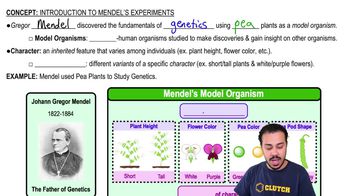
Introduction to Mendel's Experiments
14948
views
313
rank
이 집합의 용어 (61)
하이드의 정의
Result of crossing true-breeding purple-flowered and white-flowered pea plants
All offspring have purple flowers, showing purple is the dominant allele.
Phenotypic ratio of seed color in F1 x F1 cross (yellow x green seeds)
Expected ratio is 3 yellow : 1 green, with yellow dominant over green.
Allele for purple flowers in Mendel's pea plants
The purple flower allele is
dominant
.
Genotype of an individual heterozygous for dimples
The genotype is
heterozygous
, having one dominant and one recessive allele.
Definition of homozygous
Having two identical alleles for a particular gene.
Crosses that produce only heterozygous offspring
Crossing two homozygous parents with different alleles (e.g., AA x aa).
Purpose of a test cross
Cross an individual with a dominant phenotype to a homozygous recessive to determine genotype.
Significance of an AaBb individual producing four gametes equally
Demonstrates
independent assortment
of alleles.
Probability next child is male after two female children
The probability remains 50%, independent of previous children.
Inheritance pattern of achondroplasia
Dominant allele causes condition; homozygous dominant is lethal; heterozygotes show dwarfism.
Example of an organism that reproduces asexually
Bacteria reproduce asexually by binary fission.
Location of chromosomes in eukaryotic cells
Chromosomes are located in the
nucleus
.
Components of chromatin
Chromatin consists of DNA wrapped around histone proteins.
Components of a duplicated chromosome
Two sister chromatids joined at a centromere.
Events of interphase
Cell grows, DNA replicates, and prepares for mitosis.
Events of prophase in mitosis
Chromosomes condense, nuclear envelope breaks down, spindle fibers form.
Correct sequence of mitosis stages
Prophase → Metaphase → Anaphase → Telophase.
Events of metaphase
Chromosomes align at the cell's equator.
Events of anaphase
Sister chromatids separate and move to opposite poles.
Stage when cytokinesis typically occurs
Cytokinesis usually occurs during
telophase
.
Sex chromosomes of a normal human male
XY chromosomes.
Definition of autosomes
Chromosomes that do not determine sex.
Result of sexual intercourse in humans
Fertilization produces a diploid zygote.
Events during metaphase I of meiosis
Homologous chromosome pairs align at the metaphase plate.
Unique characteristic of prophase I
Crossing over occurs between homologous chromosomes.
Difference between anaphase II and mitotic anaphase
Anaphase II separates sister chromatids; mitotic anaphase also separates sister chromatids.
Difference between mitosis and meiosis
Mitosis produces two identical diploid cells; meiosis produces four genetically diverse haploid cells.
Result of crossing over during prophase I
Genetic recombination increases genetic diversity.
Components of nucleosomes
DNA wrapped around histone protein cores.
Definition of karyotype
A visual profile of an individual's chromosomes.
Technique to collect fetal cells for genetic testing
Amniocentesis.
Key to recognizing codominance
Both alleles are fully expressed in the heterozygote.
Many human traits like intelligence are
Polygenic and influenced by multiple genes and environment.
Explanation for BbCc x bbcc cross producing 5:5:1:1 ratio
Shows linked genes with some recombination.
Probability second child has recessive disease if both parents heterozygous
25% chance the child will have the disease.
Backbone of DNA
Sugar-phosphate backbone.
RNA base replacing thymine in DNA
Uracil replaces thymine in RNA.
Percentage of guanine if adenine is 20% in DNA
Guanine is 30% due to base pairing rules.
Base pairing in DNA
Adenine pairs with thymine; guanine pairs with cytosine.
What happens after DNA replication
Two identical DNA molecules are formed.
Enzymes joining nucleotides during replication
DNA polymerases.
Number of nucleotides in a codon
Three nucleotides.
Shared genetic code evidence
All life shares a common evolutionary origin.
Expressed regions of eukaryotic genes
Exons.
Translation converts information from
mRNA to polypeptide (protein).
RNA translated into polypeptide
Messenger RNA (mRNA).
Sequence of events during transcription
Initiation, elongation, termination.
Location of translation
At the ribosome in the cytoplasm.
Peptide bonds form between
Amino acids during protein synthesis.
Ultimate source of all diversity
Genetic mutation.
Flow of genetic information from DNA to RNA
Transcription.
Effect of a premature stop codon mutation
Produces a truncated, usually nonfunctional protein.
Amino acid for codon AGC
Serine.
Examples of genetic diseases: autosomal recessive
Cystic fibrosis, sickle cell anemia.
Examples of genetic diseases: autosomal dominant
Achondroplasia, Huntington's disease.
Examples of sex-linked traits
Hemophilia, color blindness.
Examples of chromosomal defects
Down syndrome, Turner syndrome.
Definition of aneuploidy
Abnormal number of chromosomes.
Difference between transcription and translation
Transcription makes RNA from DNA; translation makes protein from mRNA.
Functions of mRNA, tRNA, and rRNA
mRNA: carries genetic code
tRNA: brings amino acids
rRNA: forms ribosome structure
Function of ribosome
Site of protein synthesis.
 뒤로
뒤로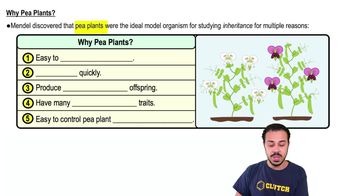
 01:58
01:58
 뒤로
뒤로