 뒤로
뒤로General Biology: Genetics, Cell Division, and Evolution
 03:21
03:21
이 집합의 용어 (21)
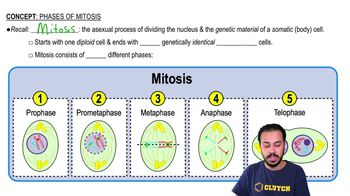
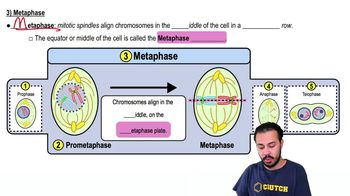
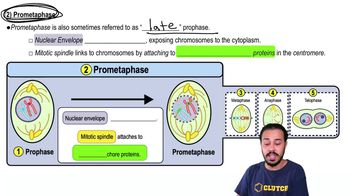
Mitosis stages: Prophase, Metaphase, Anaphase, Telophase; results in two identical diploid daughter cells.
Meiosis stages: Meiosis I (Prophase I, Metaphase I, Anaphase I, Telophase I) and Meiosis II (Prophase II, Metaphase II, Anaphase II, Telophase II); produces four haploid gametes.
Mitosis produces two diploid identical cells; meiosis produces four haploid genetically diverse gametes.
An allele is a variant form of a gene found at a specific locus on a chromosome.
Homozygous: two identical alleles; heterozygous: two different alleles for a gene.
Dominant allele expresses its trait when present; recessive allele expresses only if two copies are present.
Genotype is the genetic makeup; phenotype is the observable trait or characteristic.
A monohybrid cross uses a Punnett square to predict offspring genotypes and phenotypes for one gene.
Incomplete dominance results in a blended phenotype when heterozygous (e.g., red + white = pink).
Co-dominance shows both alleles fully expressed in heterozygotes (e.g., blood type AB).
Polygenic inheritance involves multiple genes contributing to a single trait (e.g., skin color).
Use family history and inheritance patterns to determine genotypes and predict traits in pedigrees.
Use Punnett squares considering males (XY) and females (XX) to predict inheritance of X-linked traits.
Includes deletions, duplications, inversions, translocations, and aneuploidy (e.g., Down syndrome).
Disorders can be autosomal dominant, autosomal recessive, X-linked, or chromosomal with characteristic symptoms.
The theory of evolution explains species change over time through natural selection and genetic variation.
Includes homologous structures (common ancestry), analogous structures (similar function), and vestigial organs (reduced function).
Genetic drift includes bottleneck effect and founder effect, causing random allele frequency changes in populations.
Gene flow is the transfer of alleles between populations through migration.
Humans and primates share a recent common ancestor, supported by genetic and anatomical evidence.
Shows gradual changes in brain size, bipedalism, and tool use leading to modern humans.