 뒤로
뒤로General Biology I Chapter 11 Key Concepts
 04:25
04:25
이 집합의 용어 (32)
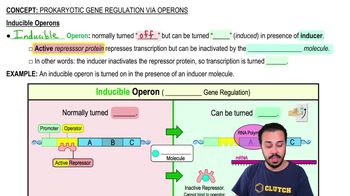
The lac operon is regulated by a repressor that binds the operator to block transcription; it is inactivated by lactose, allowing gene expression.
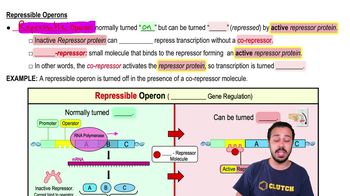
The trp operon is regulated by a repressor activated by tryptophan, which binds the operator to inhibit transcription when tryptophan is abundant.
Some operons are controlled by activators that bind DNA and increase RNA polymerase binding, enhancing transcription.
Selective gene expression allows different cell types to arise by expressing only specific subsets of genes.
DNA is wrapped around histones forming nucleosomes, which further coil and fold to form chromosomes.
The pattern results from X chromosome inactivation in female cats, producing patches of cells expressing different alleles.
Gene expression is controlled at multiple levels: chromatin structure, transcription, RNA processing, translation, and post-translation.
Alternative splicing allows a single gene to produce multiple mRNA variants by including or excluding certain exons.
The rate of mRNA degradation affects how much protein is produced from a transcript.
Control of translation initiation determines whether ribosomes assemble on mRNA to start protein synthesis.
Proteins can be activated or inactivated by modifications, and their degradation controls protein levels.
Plant cloning shows that differentiated cells can revert to a totipotent state and generate a whole organism.
Reproductive cloning produces a new organism genetically identical to the donor by nuclear transplantation.
Therapeutic cloning aims to produce embryonic stem cells for medical treatment, not a whole organism.
Gene cloning copies DNA fragments; reproductive cloning creates whole organisms; therapeutic cloning produces stem cells.
Some viruses can insert oncogenes or disrupt normal genes, contributing to cancer development.
Proto-oncogenes are normal genes that can become oncogenes and promote uncontrolled cell division when mutated.
Tumor-suppressor genes normally inhibit cell division; their loss or mutation can lead to cancer.
Cancer usually requires multiple mutations accumulating over time, making its development gradual.
An activator is a protein that binds DNA to increase transcription of a gene.
An adult stem cell is a partially differentiated cell that can produce some but not all cell types.
A Barr body is the inactivated X chromosome visible in female cell nuclei.
A carcinogen is a substance that can cause mutations leading to cancer.
A clone is an organism or cell genetically identical to the original.
Differentiation is the process by which cells become specialized in structure and function.
A DNA microarray is a tool used to measure expression levels of many genes simultaneously.
An embryonic stem cell is a pluripotent cell derived from early embryos that can become any cell type.
An enhancer is a DNA sequence that increases transcription from a distance by binding activators.
Epigenetic inheritance involves heritable changes in gene expression without changes in DNA sequence.
miRNAs are small RNAs that regulate gene expression by degrading mRNA or blocking translation.
Nuclear transplantation is transferring a nucleus from a donor cell into an egg cell to clone an organism.
Nucleic acid hybridization is a technique to detect specific DNA or RNA sequences by complementary base pairing.