 뒤로
뒤로General Biology I Chapter 12: DNA Technology and Genetic Engineering
 03:12
03:12
이 집합의 용어 (28)
A small, circular DNA molecule found in bacteria used as a vector to carry foreign DNA into host cells during gene cloning.
An enzyme that cuts DNA at specific sequences called restriction sites, producing restriction fragments used in DNA cloning.
An enzyme that joins DNA fragments by forming phosphodiester bonds, used to seal foreign DNA into plasmids.
The process of producing multiple copies of a specific gene by inserting it into a plasmid and replicating it in a host organism.
A technique used to amplify a specific DNA sequence exponentially using primers, DNA polymerase, and thermal cycling.
A method to separate DNA or proteins by size using an electric field to move molecules through a gel matrix.
A gene editing tool that uses a guide RNA and Cas9 enzyme to make precise cuts in DNA for targeted modifications.
Organisms whose genomes have been altered by genetic engineering to express desired traits, often used in agriculture.
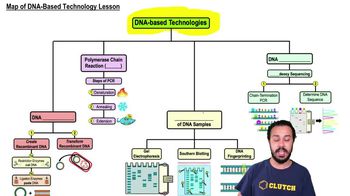
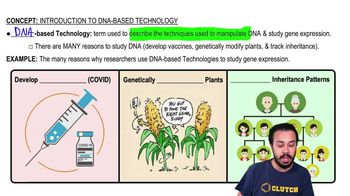
Techniques used to manipulate DNA for research, medicine, agriculture, and forensic applications.
An international research effort to sequence and map all human genes, providing a foundation for genomics and medicine.
The use of computer technology to store, analyze, and interpret biological data, especially DNA sequences.
DNA synthesized from an mRNA template using reverse transcriptase, representing expressed genes without introns.
A forensic technique that uses patterns in DNA, such as short tandem repeats (STRs), to identify individuals.
Repeating sequences of 2-5 base pairs in DNA used in genetic fingerprinting and DNA profiling.
A labeled single-stranded DNA or RNA molecule used to detect complementary sequences in DNA samples.
DNA molecules formed by combining DNA from different sources, often used in genetic engineering.
A DNA molecule, such as a plasmid, used to carry foreign DNA into a host cell for cloning or expression.
The insertion of genes into an individual's cells to treat or prevent disease.
The large-scale study of proteins, their structures, and functions.
A sequencing approach that breaks the genome into small fragments, sequences them, and assembles the sequences using computers.
Short DNA sequences that provide a starting point for DNA synthesis during PCR.
An enzyme that synthesizes DNA from an RNA template, used to create cDNA.
The application of DNA technology to legal cases, including identification and crime scene analysis.
An organism that contains genes from another species introduced by genetic engineering.
A preparation that stimulates the immune system to recognize and fight pathogens, sometimes produced using recombinant DNA technology.
The use of living organisms or their products to develop useful products and technologies.
The process of making multiple identical copies of a DNA fragment.
Sequences that are repeated many times in the genome, often used in DNA profiling.