 뒤로
뒤로General Biology: Key Concepts and Organization
 09:50
09:50
이 집합의 용어 (23)
Biology is the scientific study of life and living organisms, exploring their composition, functions, growth, changes, and interactions with each other and the environment.
Organization, Information, Energy and Matter, Interactions, and Evolution are the five major themes that help organize biological study.
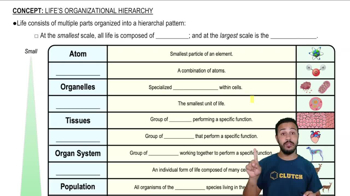
Molecule → Organelle → Cell → Tissue → Organ → Organ system → Organism.
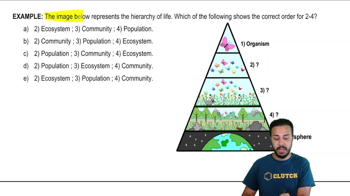
Organism → Population → Community → Ecosystem → Biosphere.
Molecules are chemical building blocks of life like DNA, proteins, lipids, and carbohydrates that form structures necessary for cell function.
Organelles are specialized structures within cells, such as mitochondria and nucleus, made of molecules and performing specific functions.
Cells are the basic unit of life; organisms can be unicellular or multicellular, with cells containing organelles to carry out life processes.
Tissues are groups of similar cells working together to perform specific functions, like muscle tissue contracting or nervous tissue transmitting signals.
Organs are structures composed of different tissues working together for particular functions, such as the heart pumping blood.
Populations are groups of organisms of the same species living in the same area at the same time.
Communities are groups of populations of different species living and interacting in the same area.
Ecosystems are communities of populations interacting with each other and their physical environment, including both biotic and abiotic components.
The biosphere is the sum of all ecosystems on Earth, including every region where life exists.
Levels help organize complex information and answer different biological questions at appropriate scales, revealing new properties from interactions.
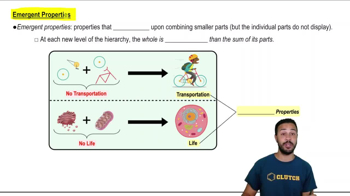
Emergent properties are new features that appear at higher levels of organization due to interactions among parts, like heart cells contracting individually vs. pumping blood collectively.
At each biological level, structure correlates with function; analyzing structure provides clues about how biological systems work.
Genetic information stored in DNA provides instructions for building, functioning, and maintaining life, and is copied during cell division.
Energy enters ecosystems as sunlight, is captured by plants, flows through food chains, and eventually leaves as heat; it is not recycled.
Matter like carbon and nitrogen cycles between organisms and the environment, being reused and recycled repeatedly.
Interactions include mutualism (both benefit), parasitism (one benefits, host harmed), predation (one kills another), and competition (both negatively affected).
Evolution is change in populations across generations involving heritable traits, leading to similarities and differences among organisms.
Living organisms share common ancestry; species with recent common ancestors are more closely related, explaining similarities.
Divergence occurs when populations accumulate independent changes over generations, increasing biological diversity.