Skip to main content
General Biology
나의 코스
배우기
시험 준비
AI 튜터
학습 가이드
교과서적 해결책
플래시카드
탐험해 보세요
앱을 사용해 보세요
나의 코스
배우기
시험 준비
AI 튜터
학습 가이드
교과서적 해결책
플래시카드
탐험해 보세요
앱을 사용해 보세요
뒤로
General Biology Key Concepts
카드를 뒤집기 위해 탭할 수 있습니다.
Five fundamental characteristics of living organisms
카드를 뒤집기 위해 탭할 수 있습니다.
👆
Five fundamental characteristics of living organisms
Cells
,
Replication
,
Information processing
,
Energy use
, and
Evolution
.
진행 상황 추적
컨트롤 버튼이 '내비게이션' 모드로 변경되었습니다.
1/27
추천 영상
01:35
Scientific Method Example 1
11442
views
256
rank
03:03
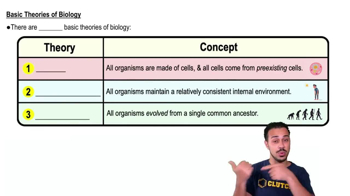
Basic Theories of Biology
12153
views
240
rank
1
comments
06:29
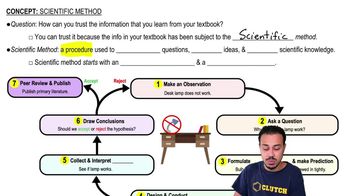
Scientific Method
19686
views
448
rank
1
comments
이 집합의 용어 (27)
하이드의 정의
Five fundamental characteristics of living organisms
Cells
,
Replication
,
Information processing
,
Energy use
, and
Evolution
.
Cell theory
All organisms are made of membrane-bound cells, and all cells come from preexisting cells.
Basic atomic structure
Atoms have a nucleus with protons (+) and neutrons (neutral), surrounded by electrons (-).
Isotopes
Atoms of the same element with different numbers of neutrons and different atomic masses.
Valence electrons and valence
Electrons in the outermost shell; valence is the number of unpaired valence electrons.
Covalent bond
A chemical bond formed by sharing unpaired valence electrons between two atoms.
Difference between nonpolar and polar covalent bonds
Nonpolar bonds share electrons equally; polar bonds share unequally due to electronegativity differences.
Water polarity and hydrogen bonding
Water is polar with partial charges; hydrogen bonds form between water molecules.
Amino acid structure
Consists of an amino group, carboxyl group, central carbon, and a unique side chain (R-group).
Protein secondary structure
Formed by hydrogen bonds between amino and carbonyl groups; includes α-helix and β-pleated sheets.
Types of R-group interactions in protein tertiary structure
Hydrogen bonds, hydrophobic interactions, van der Waals, covalent (disulfide), and ionic bonds.
Carbohydrate molecular formula
General formula is (C H2O)n, where n varies from 3 to over 1000.
Energy storage in carbohydrates
Electrons in C–H and C–C bonds have higher potential energy than in C=O and C–O bonds.
Lipids and their insolubility
Carbon-containing compounds insoluble in water due to high proportion of nonpolar C–H bonds.
Fatty acid saturation effects
Double bonds create kinks preventing tight packing; saturated fats are solid, unsaturated fats are liquid at room temperature.
Phospholipid bilayer structure
Amphipathic lipids with hydrophilic heads and hydrophobic tails form bilayers spontaneously in water.
Diffusion and osmosis
Diffusion is movement from high to low concentration; osmosis is diffusion of water across selectively permeable membranes.
Membrane protein types
Integral (transmembrane) proteins span the membrane; peripheral proteins bind to membrane surfaces.
Active vs passive transport
Passive transport moves substances down concentration gradients without energy; active transport requires energy to move substances against gradients.
Fluid-mosaic model of membranes
Membranes are dynamic mosaics of phospholipids and proteins, allowing fluidity and selective permeability.
Cytoskeleton filament types and functions
Actin filaments resist tension, intermediate filaments maintain cell shape, microtubules resist compression and assist intracellular transport.
Cellular respiration overview
Glucose is oxidized to CO2; energy released is used to produce ATP via glycolysis, citric acid cycle, and electron transport chain.
Fermentation purpose
Regenerates NAD+ from NADH allowing glycolysis and ATP production to continue without oxygen.
Photosynthesis overall reaction
Converts CO2 and H2O into carbohydrates and O2 using light energy.
Calvin cycle phases
Fixation of CO2, reduction of 3PGA to G3P, and regeneration of RuBP.
Cell cycle checkpoints
G1, G2, and M phase checkpoints ensure cell size, DNA integrity, and chromosome alignment before division.
Mitosis vs meiosis key differences
Mitosis produces identical diploid cells; meiosis produces haploid cells with genetic variation through two divisions.
 뒤로뒤로
뒤로뒤로
 01:35
01:35