Skip to main content
General Biology
나의 코스
배우기
시험 준비
AI 튜터
학습 가이드
교과서적 해결책
플래시카드
탐험해 보세요
앱을 사용해 보세요
나의 코스
배우기
시험 준비
AI 튜터
학습 가이드
교과서적 해결책
플래시카드
탐험해 보세요
앱을 사용해 보세요
뒤로
General Biology Key Concepts
카드를 뒤집기 위해 탭할 수 있습니다.
Smallest unit of life
카드를 뒤집기 위해 탭할 수 있습니다.
👆
Smallest unit of life
The
cell
is the smallest unit of organization that can perform all activities required for life.
진행 상황 추적
컨트롤 버튼이 '내비게이션' 모드로 변경되었습니다.
1/30
추천 영상
09:26
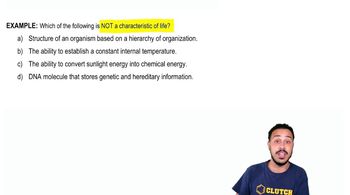
Characteristics of Life
41679
views
1159
rank
8
comments
02:59
Characteristics of Life Example 1
23703
views
705
rank
3
comments
이 집합의 용어 (30)
하이드의 정의
Smallest unit of life
The
cell
is the smallest unit of organization that can perform all activities required for life.
Most common feedback mechanism in biology
Negative feedback
is the most common feedback mechanism in biological systems.
Main function of DNA
DNA's main function is
storing genetic information
in cells.
Definition of an ecosystem
An
ecosystem
is a community of living organisms and their interactions with the environment.
Proteomics
The study of sets of proteins and their properties, including abundance and interactions.
Structure containing genetic material
A
chromosome
contains genetic material in the form of DNA.
Role of insulin in blood glucose regulation
Insulin
decreases blood glucose levels
to maintain homeostasis.
Main source of energy for life on Earth
Sunlight
is the primary energy source for most life on Earth.
Emergent properties
Properties that arise from the arrangement and interaction of parts within a system as complexity increases.
Biosphere
The global ecological system integrating all living beings and their relationships with the lithosphere, hydrosphere, and atmosphere.
Difference between prokaryotic and eukaryotic cells
Prokaryotic cells lack a nucleus and membrane-enclosed organelles, unlike eukaryotic cells.
Gene expression
The process by which information from a gene is used to synthesize a functional gene product, often a protein.
Role of chlorophyll in photosynthesis
Chlorophyll absorbs sunlight to convert it into chemical energy during photosynthesis.
Feedback regulation
A process where the output of a system regulates that process, often through negative or positive feedback.
Difference between negative and positive feedback
Negative feedback reduces the effect of the initial stimulus, while positive feedback amplifies it.
Domains of life
The three domains are
Bacteria
,
Archaea
, and
Eukarya
.
Eukarya domain includes
All eukaryotic organisms such as plants, animals, fungi, and protists.
Scientific explanation for unity and diversity of life
Evolution
explains how species accumulate differences and adapt over time.
Natural selection
Process where organisms with favorable traits survive and reproduce more, leading to adaptation.
Scientific hypothesis
A testable explanation based on observations that leads to predictions.
Controlled experiment
An experiment comparing an experimental group with a control group differing in only one independent variable.
Independent variable
The factor manipulated by researchers in an experiment.
Dependent variable
The factor measured in an experiment, predicted to be affected by the independent variable.
Inductive reasoning
Deriving generalizations from a large number of specific observations.
Deductive reasoning
Predicting specific results from general premises to test hypotheses.
Model organism
A species easy to grow in the lab used to understand biological processes applicable to others.
Peer review
Evaluation of research results by other experts before publication to ensure validity.
Bioinformatics
Use of computational tools to store, organize, and analyze biological data.
Genome
The complete set of an organism's genes and noncoding DNA sequences.
Prokaryotic cell
A cell lacking a membrane-enclosed nucleus and organelles; includes bacteria and archaea.
 뒤로뒤로
뒤로뒤로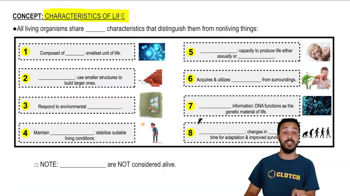
 09:26
09:26