 뒤로
뒤로General Biology: Key Concepts from Campbell Biology Chapter 1
 02:09
02:09

이 집합의 용어 (20)
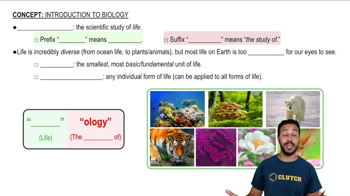
Biology is the scientific study of life, encompassing the properties and processes common to all living organisms.
Order, reproduction, growth and development, energy processing, regulation (homeostasis), response to the environment, and evolutionary adaptation.
Viruses do not exhibit all properties of life independently, such as reproduction on their own and cellular organization.
Domains Bacteria and Archaea contain prokaryotic organisms; Domain Eukarya includes protists and kingdoms Fungi, Plantae, and Animalia.
New properties that arise at each level of biological organization due to the arrangement and interactions of parts.
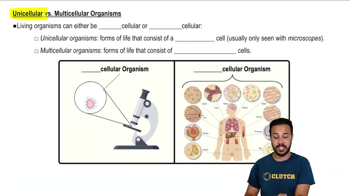
The cell is the basic structural and functional unit of all living organisms.
An evidence-based process involving observations, hypotheses, predictions, experiments, and data analysis to understand natural phenomena.
A scientific theory is a broad, well-tested explanation supported by extensive evidence, while a hypothesis is a tentative, testable explanation.
The independent variable is manipulated by the researcher; the dependent variable is the measured outcome affected by the independent variable.
An experiment comparing an experimental group with a control group to test the effect of a single variable.
By comparing natural variations or characteristics, such as DNA sequences, without manipulating variables experimentally.
It allows scientists to systematically evaluate explanations and refine understanding through evidence.
Evolution is the process of change that has transformed life on Earth, explaining the unity and diversity of organisms.
A mechanism of evolution where individuals with advantageous traits have higher reproductive success, leading to adaptation.
Through artificial selection by selectively breeding plants and animals, influencing their traits over generations.
DNA stores hereditary information and programs cellular activities by providing instructions for protein synthesis.
The structure of a biological component is closely related to its function, from molecules to whole organisms.
Energy enters as sunlight, is converted by producers to chemical energy, passed to consumers, and exits as heat.
Homeostasis is the regulation of internal conditions to maintain a stable, constant environment within an organism.
An approach to understanding biological systems by analyzing interactions among their parts to model behavior.