뒤로

General Biology: Key Concepts from Chapter 1

컨트롤 버튼이 '내비게이션' 모드로 변경되었습니다.
1/21
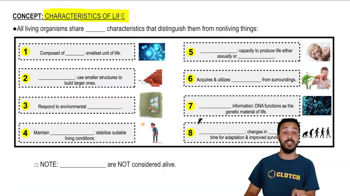
  • What are the five fundamental characteristics shared by all living organisms?

    • Cells: Organisms consist of membrane-bound cells.
    • Replication: Organisms replicate themselves.
    • Information: Organisms process hereditary information encoded in genes.
    • Energy: Organisms acquire and use energy.
    • Evolution: Organisms and populations evolve over time.
  • What is the cell theory?

    All organisms are made of cells, and all cells come from preexisting cells through cell division.
  • How did Louis Pasteur's experiment disprove spontaneous generation?

    Pasteur showed that sterilized nutrient broth remained free of organisms unless exposed to preexisting cells, proving cells arise only from existing cells.
  • What is the chromosome theory of inheritance?

    Hereditary information is encoded in genes located on chromosomes, which are passed from parents to offspring.
  • Describe the structure of DNA.

    DNA is a double-stranded helix with sequences of four bases (A, T, C, G) paired specifically (A with T, C with G) that encodes genetic information.
  • What is the central dogma of molecular biology?

    Genetic information flows from DNA to RNA to proteins, which determine an organism's traits.
  • Define evolution in biological terms.

    Evolution is the change in characteristics of a population over time through processes like natural selection.
  • What are the two key conditions for natural selection to occur?

    • Variation in heritable traits among individuals.
    • Certain traits increase survival and reproduction in a given environment.
  • What is fitness in biology?

    An individual's ability to produce viable offspring relative to others in the population.
  • What is an adaptation in biological context?

    A heritable trait that increases an individual's fitness in a particular environment.
  • What is a phylogenetic tree?

    A diagram showing evolutionary relationships among species based on common ancestry.
  • What are the three domains of life identified by genetic analysis?

    Bacteria, Archaea, and Eukarya.
  • How are scientific names of species structured?

    They use a two-part Latin name: genus (capitalized) and species (lowercase), both italicized, e.g., Homo sapiens.
  • What is the difference between prokaryotic and eukaryotic cells?

    Eukaryotic cells have a membrane-bound nucleus; prokaryotic cells do not.
  • What is the significance of the tree of life?

    It represents the genealogical relationships of all living organisms tracing back to a last universal common ancestor.
  • How do desert ants navigate back to their nest according to the pedometer hypothesis?

    They track the number of steps and stride length to calculate distance traveled and return in a straight line.
  • What is a null hypothesis in scientific experiments?

    A statement predicting no effect or no difference, used as a baseline to test the validity of the main hypothesis.
  • Why is it important to have controls in experiments?

    Controls help isolate the effect of the variable being tested by eliminating alternative explanations.
  • What is the process of hypothesis testing in biology?

    State a precise hypothesis, list predictions, design experiments or observations to test predictions, and analyze results to support or reject the hypothesis.
  • What did studies on giraffe neck length suggest about the food competition hypothesis?

    Giraffes usually feed below their full height, casting doubt on the idea that long necks evolved solely to reach high food.
  • What alternative hypothesis explains giraffe neck length?

    The sexual competition hypothesis suggests long necks evolved to improve fighting ability among males for mating opportunities.