 뒤로
뒤로General Biology: Molecular Basis of Inheritance and Gene Expression
 08:56
08:56
이 집합의 용어 (28)
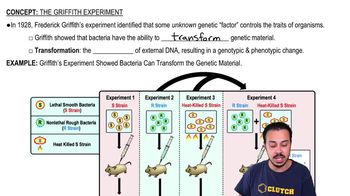
Transformation is the process by which genetic material from one organism is taken up by another, changing its genotype.
Chargaff’s rules state that DNA base pairs are complementary: adenine pairs with thymine, and guanine pairs with cytosine, in equal amounts.
The DNA double helix consists of two antiparallel strands twisted around each other, with complementary base pairing holding them together.
Antiparallel means the two DNA strands run in opposite directions: one 5’ to 3’, the other 3’ to 5’.
Semiconservative replication produces two DNA molecules each with one original strand and one new strand.
Helicase unwinds the DNA double helix by breaking hydrogen bonds, creating replication forks.
The leading strand is synthesized continuously in the 5’ to 3’ direction toward the replication fork.
The lagging strand is synthesized discontinuously as Okazaki fragments away from the replication fork.
DNA polymerase III adds nucleotides to the growing DNA strand during replication.
DNA ligase joins Okazaki fragments by forming phosphodiester bonds to complete the lagging strand.
An RNA primer is a short RNA sequence that provides a starting point for DNA synthesis.
Telomeres are repetitive DNA sequences at chromosome ends; telomerase extends these to prevent loss during replication.
Chromatin is DNA-protein complex in the nucleus; a chromosome is a condensed chromatin structure visible during cell division.
The central dogma describes the flow of genetic information: DNA → RNA → Protein.
Transcription is the process of synthesizing RNA from a DNA template in the nucleus.
Translation is the process of synthesizing a protein from mRNA at the ribosome in the cytoplasm.
mRNA carries the genetic code, tRNA brings amino acids, and rRNA forms the ribosome.
A codon is a three-nucleotide mRNA sequence; the anticodon is the complementary tRNA sequence that pairs with it.
RNA splicing removes introns from the primary transcript and joins exons to form mature mRNA.
Spliceosomes are complexes that excise introns and splice exons during RNA processing.
The 5’ cap and poly-A tail protect mRNA from degradation and assist in export and translation.
The translation initiation complex forms at the 5’ end of mRNA to start protein synthesis.
During translation, tRNA moves through the ribosome sites: A (aminoacyl), P (peptidyl), and E (exit).
Point mutations include substitutions, insertions, and deletions that can alter amino acid sequences.
A missense mutation changes one amino acid; a nonsense mutation creates a stop codon prematurely.
Frameshift mutations result from insertions or deletions that shift the reading frame of the genetic code.
Beadle and Tatum showed that genes direct the production of specific enzymes, linking genes to proteins.
Proteins have specific structures that determine their function; enzymes are proteins that catalyze biochemical reactions.