 뒤로
뒤로General Biology: Principles of Biology - Elements, Atoms, and Chemical Bonds
 02:13
02:13
이 집합의 용어 (21)
Biology is the scientific study of life, encompassing the study of living organisms and their vital processes.
Organization, Information, Energy and Matter, Interactions, and Evolution.
Matter is anything that has mass and takes up space; organisms are composed of matter.
An element is a substance that cannot be chemically broken down and consists of the same type of atoms.
A compound is a substance made of two or more elements chemically combined in a fixed ratio, with properties different from its constituent elements.
Oxygen (O), Carbon (C), Hydrogen (H), and Nitrogen (N).
Trace elements are elements required by organisms in very small amounts, e.g., iron (Fe) and iodine (I).
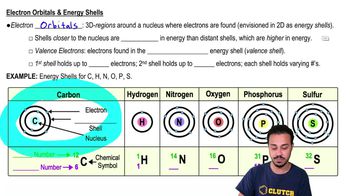
An atom consists of a nucleus containing protons (+) and neutrons (neutral), with electrons (-) orbiting in shells around the nucleus.
The structure of its atoms, especially the number and arrangement of electrons.
Atomic number is the number of protons; mass number is the total number of protons and neutrons in the nucleus.
Atoms of the same element with the same number of protons but different numbers of neutrons.
Ratios of stable isotopes (e.g., carbon-12 and carbon-13) help establish feeding links in trophic ecology.
The time it takes for half of the unstable atoms in a sample to undergo radioactive decay.
Only electrons interact during chemical reactions, as nuclei do not come close enough to interact.
Energy electrons possess due to their position relative to the nucleus; electrons farther from the nucleus have higher potential energy.
Valence electrons are electrons in the outermost shell; they determine an atom's chemical behavior and bonding.
Ionic bonds form by transfer of electrons creating charged ions; covalent bonds form by sharing electron pairs between atoms.
Electronegativity is an atom's ability to attract electrons towards its nucleus in a chemical bond.
A covalent bond where electrons are shared unequally due to differences in electronegativity, creating partial charges.
Weak bonds formed when a hydrogen atom covalently bonded to one electronegative atom is attracted to another electronegative atom.
Weak, transient attractions between molecules due to temporary charge separations caused by electron movement.