뒤로

General Biology: Structure and Function of Large Biomolecules

컨트롤 버튼이 '내비게이션' 모드로 변경되었습니다.
1/36
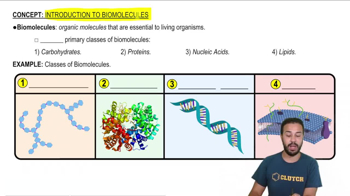
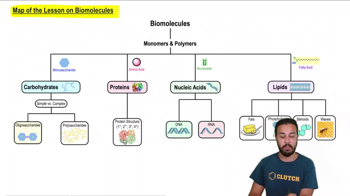
  • What are the four main classes of large molecules in living things?

    Carbohydrates, lipids, proteins, and nucleic acids.
  • Define polymer and monomer.

    Polymer: A large molecule made of repeating units. Monomer: The smaller building block that makes up a polymer.
  • What type of reaction connects monomers to form polymers?

    Dehydration synthesis, where a molecule of water is removed to join monomers.
  • What reaction breaks down polymers into monomers?

    Hydrolysis, which uses water to break bonds between monomers.
  • What do the root words 'hydro' and 'lysis' mean?

    Hydro means water, and lysis means to break or split.
  • What are the monomers of carbohydrates?

    Monosaccharides, simple sugars like glucose.
  • What is the general formula of hexose sugars?

    C6H12O6, a six-carbon sugar.
  • Name the two functional groups common to all sugars.

    Carbonyl group (C=O) and hydroxyl group (-OH).
  • Difference between aldehyde sugar and ketone sugar?

    Aldehyde sugars have the carbonyl group at the end of the carbon chain; ketone sugars have it within the chain.
  • What term describes compounds with the same molecular formula but different structures?

    Isomers.
  • What does the suffix '-ose' mean in sugar names?

    It means sugar.
  • What is a glycosidic linkage?

    A covalent bond formed between two monosaccharides by dehydration synthesis.
  • Why can't humans digest cellulose?

    Humans lack enzymes to break beta glycosidic linkages in cellulose; some bacteria and fungi can digest it.
  • What characteristic do all lipids share?

    They are hydrophobic or water-insoluble.
  • What are the building blocks of fats?

    Glycerol and fatty acids.
  • How many water molecules are removed to form a fat from three fatty acids and one glycerol?

    Three water molecules are removed by dehydration synthesis.
  • What is the difference between saturated and unsaturated fats?

    Saturated fats have no double bonds in fatty acid chains; unsaturated fats have one or more double bonds.
  • Why are many unsaturated fats liquid at room temperature?

    Double bonds create kinks that prevent tight packing, making them liquid.
  • What is a trans fat and why limit it?

    A trans fat is an unsaturated fat with trans double bonds; they increase risk of heart disease.
  • What are the four important functions of fats?

    • Energy storage
    • Insulation
    • Cushioning organs
    • Cell membrane structure
  • What is the structure of a phospholipid?

    A glycerol attached to a phosphate group (hydrophilic head) and two fatty acid chains (hydrophobic tails).
  • Why are phospholipid tails hydrophobic?

    They are composed of nonpolar hydrocarbon chains that repel water.
  • What are the monomers of proteins?

    Amino acids.
  • What does the R group in an amino acid represent?

    The side chain that varies among amino acids and determines their properties.
  • Define peptide bond, dipeptide, and polypeptide.

    Peptide bond: covalent bond between amino acids. Dipeptide: two amino acids linked. Polypeptide: chain of many amino acids.
  • Name the four levels of protein structure.

    • Primary: amino acid sequence
    • Secondary: α helix and β pleated sheet
    • Tertiary: 3D folding
    • Quaternary: multiple polypeptides
  • What causes sickle-cell disease at the protein level?

    A mutation changes the primary structure of hemoglobin, altering its shape and function.
  • What is protein denaturation and how can it occur?

    Loss of protein structure and function due to heat, pH changes, or chemicals.
  • What are chaperone proteins?

    Proteins that assist in the proper folding of other proteins.
  • What is the flow of genetic information?

    DNA is transcribed to RNA, which is translated into protein.
  • What are the three components of a nucleotide?

    Sugar, nitrogenous base, and phosphate group.
  • Which nitrogenous bases are found in DNA?

    Adenine, Thymine, Cytosine, Guanine.
  • Which nitrogenous bases are found in RNA?

    Adenine, Uracil, Cytosine, Guanine.
  • How do ribose and deoxyribose sugars differ?

    Deoxyribose lacks one oxygen atom at the 2' carbon compared to ribose.
  • Why are DNA strands antiparallel?

    One strand runs 5' to 3', the other 3' to 5', allowing complementary base pairing.
  • What molecules form the 'uprights' and 'rungs' of the DNA double helix?

    'Uprights' are sugar-phosphate backbones; 'rungs' are paired nitrogenous bases.