Skip to main content
General Biology
나의 코스
배우기
시험 준비
AI 튜터
학습 가이드
교과서적 해결책
플래시카드
탐험해 보세요
앱을 사용해 보세요
나의 코스
배우기
시험 준비
AI 튜터
학습 가이드
교과서적 해결책
플래시카드
탐험해 보세요
앱을 사용해 보세요
뒤로
General Biology: Structure and Function of Large Biomolecules
카드를 뒤집기 위해 탭할 수 있습니다.
What are the four main classes of large molecules in living things?
카드를 뒤집기 위해 탭할 수 있습니다.
👆
What are the four main classes of large molecules in living things?
Carbohydrates, lipids, proteins, and nucleic acids
.
진행 상황 추적
컨트롤 버튼이 '내비게이션' 모드로 변경되었습니다.
1/30
추천 영상
01:17
Introduction to Biomolecules
26494
views
528
rank
4
comments
01:29
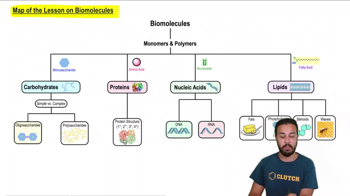
Map of the Lesson on Biomolecules
21596
views
680
rank
이 집합의 용어 (30)
하이드의 정의
What are the four main classes of large molecules in living things?
Carbohydrates, lipids, proteins, and nucleic acids
.
Define polymer and monomer.
Polymer:
large molecule made of repeating units.
Monomer:
single unit that makes up a polymer.
What type of reaction connects monomers to form polymers?
Dehydration synthesis
, where a water molecule is removed to form a covalent bond.
What reaction breaks down polymers into monomers?
Hydrolysis
, which adds water to break covalent bonds.
What do the root words 'hydro' and 'lysis' mean?
Hydro
means water,
lysis
means to break or split.
What are the monomers of carbohydrates?
Monosaccharides
, simple sugars like glucose.
What is the general formula of hexose sugars?
C6H12O6
, six-carbon sugars.
Name the two functional groups common to all sugars.
Carbonyl group (C=O)
and
hydroxyl group (-OH)
.
Difference between aldehyde sugar and ketone sugar?
Aldehyde sugars have the carbonyl group at the
end
, ketone sugars have it
within
the carbon chain.
What term describes compounds with the same molecular formula but different structures?
Isomers
.
What does the suffix '-ose' mean in sugar names?
It means
sugar
.
What is a glycosidic linkage?
A
covalent bond
formed between two sugar molecules by dehydration synthesis.
Why can't humans digest cellulose?
Humans lack enzymes to break
beta-1,4 glycosidic linkages
in cellulose; some bacteria can digest it.
What characteristic do all lipids share?
They are all
hydrophobic
molecules.
What are the building blocks of fats?
Glycerol
and
fatty acids
.
How many water molecules are removed to form a fat from three fatty acids and one glycerol?
Three
water molecules are removed by dehydration synthesis.
What makes a fatty acid unsaturated?
Presence of
one or more double bonds
between carbon atoms.
Why are many unsaturated fats liquid at room temperature?
Double bonds create
kinks
preventing tight packing, making them liquid.
What is a trans fat and why limit it?
A
hydrogenated unsaturated fat
with trans double bonds; linked to heart disease.
What are the four levels of protein structure?
Primary:
amino acid sequence.
Secondary:
α-helix and β-pleated sheets.
Tertiary:
3D folding.
Quaternary:
multiple polypeptides.
What is a peptide bond?
A
covalent bond
linking amino acids in a protein.
What causes sickle-cell disease at the protein level?
A
single amino acid mutation
changes hemoglobin structure, causing red blood cells to deform.
Define denaturation of proteins.
Loss of protein's 3D structure and function due to heat, pH changes, or chemicals.
What are chaperone proteins?
Proteins that assist in
proper folding
of other proteins.
What are the three components of a nucleotide?
Sugar
,
nitrogenous base
, and
phosphate group
.
Which nitrogenous bases are found in DNA?
Adenine (A), Thymine (T), Cytosine (C), Guanine (G)
.
Which nitrogenous bases are found in RNA?
Adenine (A), Uracil (U), Cytosine (C), Guanine (G)
.
How do ribose and deoxyribose sugars differ?
Deoxyribose lacks one oxygen atom at the 2' carbon compared to ribose.
What is the shape of DNA?
A
double helix
.
Why are DNA strands antiparallel?
One strand runs 5' to 3', the other 3' to 5', allowing complementary base pairing.
 뒤로뒤로
뒤로뒤로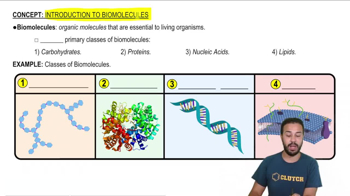
 01:17
01:17