Skip to main content
General Biology
나의 코스
배우기
시험 준비
AI 튜터
학습 가이드
교과서적 해결책
플래시카드
탐험해 보세요
앱을 사용해 보세요
나의 코스
배우기
시험 준비
AI 튜터
학습 가이드
교과서적 해결책
플래시카드
탐험해 보세요
앱을 사용해 보세요
뒤로
General Biology: The Cell Cycle
카드를 뒤집기 위해 탭할 수 있습니다.
What is the result of most cell division?
카드를 뒤집기 위해 탭할 수 있습니다.
👆
What is the result of most cell division?
Most cell division results in
genetically identical daughter cells
.
진행 상황 추적
컨트롤 버튼이 '내비게이션' 모드로 변경되었습니다.
1/21
추천 영상
04:45
Asexual vs. Sexual Reproduction
16919
views
361
rank
3
comments
09:40
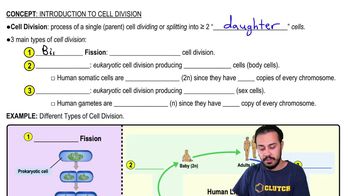
Introduction to Cell Division
25812
views
580
rank
1
comments
03:19
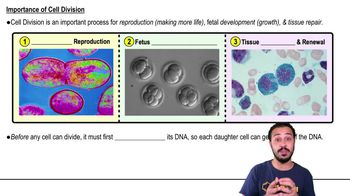
Importance of Cell Division
16113
views
518
rank
이 집합의 용어 (21)
하이드의 정의
What is the result of most cell division?
Most cell division results in
genetically identical daughter cells
.
What are the two main phases of the cell cycle?
The cell cycle alternates between the
mitotic phase
and
interphase
.
What happens during interphase?
Interphase is when the cell grows, performs normal functions, and duplicates its DNA in preparation for mitosis.
What occurs during the mitotic phase?
The mitotic phase includes
mitosis
(nuclear division) and
cytokinesis
(cytoplasm division), producing two daughter cells.
How is the eukaryotic cell cycle regulated?
The eukaryotic cell cycle is regulated by a
molecular control system
that ensures proper timing and order of events.
Why is regulation of the cell cycle important?
Regulation prevents errors like uncontrolled division or DNA damage, maintaining genetic stability.
What is the role of checkpoints in the cell cycle?
Checkpoints monitor and verify whether the processes at each phase have been accurately completed before progression.
Name the main checkpoints in the cell cycle.
The main checkpoints are the
G1 checkpoint
,
G2 checkpoint
, and
metaphase checkpoint
.
What happens at the G1 checkpoint?
The G1 checkpoint assesses cell size, nutrients, growth factors, and DNA integrity before DNA synthesis.
What is checked at the G2 checkpoint?
The G2 checkpoint ensures DNA replication is complete and checks for DNA damage before mitosis.
What is the metaphase checkpoint's function?
It ensures all chromosomes are properly attached to the spindle before anaphase begins.
What molecules are key regulators of the cell cycle control system?
Cyclins and cyclin-dependent kinases (
CDKs
) are key molecules regulating the cell cycle.
How do cyclins and CDKs regulate the cell cycle?
Cyclins bind to CDKs, activating them to phosphorylate target proteins that drive cell cycle progression.
What is the significance of cyclin levels fluctuating during the cell cycle?
Cyclin levels rise and fall to activate CDKs at specific times, ensuring orderly cell cycle transitions.
What is mitosis?
Mitosis is the process of nuclear division that results in two genetically identical nuclei.
What are the stages of mitosis?
The stages are
prophase
,
metaphase
,
anaphase
, and
telophase
.
What happens during prophase?
Chromosomes condense, the mitotic spindle forms, and the nuclear envelope begins to break down.
What occurs in metaphase?
Chromosomes align at the cell's equator, attached to spindle fibers.
Describe anaphase.
Sister chromatids separate and move toward opposite poles of the cell.
What happens during telophase?
Nuclear envelopes re-form around the two sets of chromosomes, which begin to decondense.
What is cytokinesis?
Cytokinesis is the division of the cytoplasm, resulting in two separate daughter cells.
 뒤로뒤로
뒤로뒤로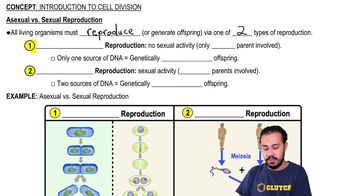
 04:45
04:45