 뒤로
뒤로General Biology: The Chemical Context of Life
 02:13
02:13
이 집합의 용어 (20)
Matter is anything that takes up space and has mass.
An element is a substance that cannot be broken down by chemical reactions. A compound consists of two or more elements in a fixed ratio with different properties from its elements.
Carbon, hydrogen, oxygen, and nitrogen make up 96% of living matter.
Atoms are composed of protons (positive charge), neutrons (no charge), and electrons (negative charge).
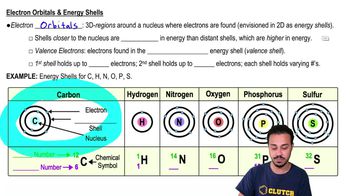
Atomic number is the number of protons in an atom's nucleus and equals the number of electrons in a neutral atom.
Atomic mass is approximated by the sum of protons and neutrons in the nucleus (mass number).
Isotopes are atoms of the same element with different numbers of neutrons.
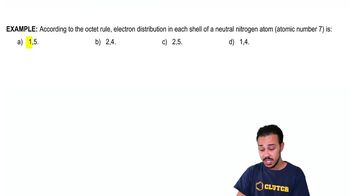
The distribution of electrons in electron shells, especially the number of valence electrons, determines chemical behavior.
Valence electrons are electrons in the outermost shell involved in chemical bonding.
A covalent bond is a chemical bond formed by sharing a pair of valence electrons between two atoms.
A single bond shares one pair of electrons; a double bond shares two pairs.
Electronegativity is an atom's attraction for electrons in a covalent bond.
Nonpolar covalent bonds share electrons equally; polar covalent bonds share electrons unequally due to differing electronegativities.
Unequal sharing of electrons causes partial negative (δ–) and partial positive (δ+) charges, creating polarity.
An ionic bond forms when one atom transfers electrons to another, creating oppositely charged ions that attract.
Cations are positively charged ions; anions are negatively charged ions.
A hydrogen bond is a weak attraction between a hydrogen atom covalently bonded to an electronegative atom and another electronegative atom.
They stabilize DNA, help protein folding, and contribute to water's unique properties.
Weak attractions due to temporary partial charges from uneven electron distribution in molecules close together.
Molecular shape, determined by orbital positions and bonding, affects how molecules recognize and respond to each other.