 뒤로
뒤로General Biology: Themes of Life & Biological Organization
 02:09
02:09

이 집합의 용어 (28)
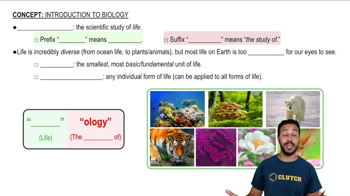
Biology is the scientific study of life, examining living things from molecular levels to the entire biosphere.
Organization, Information, Energy and Matter, Interactions, and Evolution.
Atoms → Molecules → Organelles → Cells → Tissues → Organs → Organ systems → Organism → Population → Community → Ecosystem → Biosphere.
Evolution is the change in DNA of a population over multiple generations, driven by natural selection and adaptation.
Order, Response to environment, Reproduction, Growth & development, Energy processing, Regulation, Evolutionary adaptation.
Structure helps us understand what it does. Function helps us understand how it works and organized. Ex. structure - birds beak
Function - the beak allows to reach for food
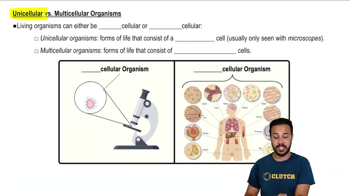
All living organisms are made up of cells, the smallest units capable of performing life activities.
Prokaryotic cells lack a nucleus and membrane-bound organelles; eukaryotic cells have a nucleus and organelles, and are usually larger and more complex.
DNA (Deoxyribonucleic Acid) contains genetic material organized in chromosomes, directing organism development and inheritance.
DNA is a double helix made of two chains of nucleotides: adenine (A), thymine (T), cytosine (C), and guanine (G), storing genetic information in their sequence.
Gene expression is the process where DNA is transcribed into mRNA, then translated into proteins that perform cellular functions.
Different cells express different subsets of genes, producing distinct proteins and functions despite identical DNA.
Producers (autotrophs) make their own food, consumers (heterotrophs) eat other organisms, decomposers feed on wastes and dead matter.
Energy flows one way: from the sun to producers, then consumers, and finally lost as heat.
How biological systems monitor themselves and maintain balance. It tells the system to speed up or slow down.
Negative feedback counteracts changes to maintain stability; positive feedback amplifies changes until a goal is reached.
Organisms interact with each other and their environment, affecting and altering their surroundings and relationships.
It means all living organisms are modified descendants of common ancestors, explaining unity and diversity of life.
Bacteria (prokaryotes), Archaea (prokaryotes in extreme environments), and Eukarya (organisms with eukaryotic cells).
Kingdom Plantae (multicellular plants), Kingdom Fungi (mostly unicellular fungi), Kingdom Animalia (multicellular animals), and Protists (mostly single-celled eukaryotes).
Variation, Heritability, Competition, Differential reproductive success, and Change over generations.
An adaptation is an inherited trait that increases an organism's survival and reproductive success in its environment.
Natural selection acts on heritable variation, favoring advantageous traits that become more common in populations over generations.
A branching diagram showing evolutionary relationships, where species descend from common ancestors, illustrating life's diversity and unity.
What is organization?
The structure that it builds up Ex. Cells -> Molecules -> Tissues -> Organ (heart)
What is information?
Gene information has all the code that we need.
What is Energy and Matter?
Energy cannot be created nor destroyed. The ultimate source of energy is the sun.
What is interactions?
Constantly interacting with the environments such as animals, different wave lengths from the sun, etc.