 뒤로
뒤로General Biology Unit 1 Review
 02:09
02:09

이 집합의 용어 (38)
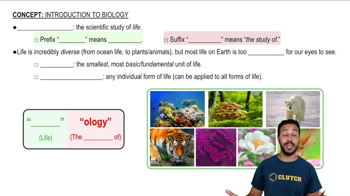
Properties of life include organization, metabolism, homeostasis, growth, reproduction, response to stimuli, and evolution. Each property helps define living organisms.
Levels range from molecules to biosphere: molecule, organelle, cell, tissue, organ, organism, population, community, ecosystem, biosphere. Each level builds on the previous with emergent properties.
Emergent properties arise when components interact at a higher level, producing new functions not seen at lower levels, e.g., cells form tissues with new functions.
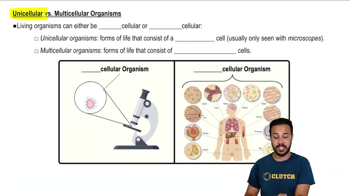
Eukaryotic cells have a nucleus and organelles; prokaryotic cells lack a nucleus. Eukarya domain has eukaryotes; Bacteria and Archaea domains have prokaryotes.
Domains: Bacteria and Archaea (prokaryotes), Eukarya (eukaryotes). Kingdoms in Eukarya include Protista, Fungi, Plantae, and Animalia.
DNA stores genetic information that guides development, function, and reproduction of organisms.
Genetic information flows from DNA to RNA to proteins, enabling cells to produce functional molecules.
Energy comes mainly from the sun; organisms obtain it by photosynthesis or consumption. Energy flows through ecosystems and is not recycled.
Matter cycles through ecosystems, being rearranged but not created or destroyed, unlike energy which flows through.
Negative feedback reduces change to maintain stability; positive feedback amplifies change, often leading to a specific outcome.
Genetic makeup of populations changes over time as individuals with advantageous traits survive and reproduce more, passing traits to future generations.
Includes independent variable (manipulated), dependent variable (measured), and a control group for comparison.
Inductive reasoning derives generalizations from observations; deductive reasoning applies general principles to predict specific outcomes.
Matter is anything with mass and volume; elements are pure substances of one atom type; compounds are combinations of elements with new properties.
Carbon, Hydrogen, Oxygen, and Nitrogen are most common. Carbon forms 4 bonds, Hydrogen 1, Oxygen 2, Nitrogen 3, affecting molecular structure and function.
Trace elements are required in small amounts for biological functions, e.g., iron for oxygen transport.
Atoms consist of protons (positive charge), neutrons (neutral), and electrons (negative charge) determining chemical properties.
Atomic number = number of protons; mass number = protons + neutrons. Changing protons changes the element.
Atoms of the same element with different neutron numbers. Used in biology for dating fossils and medical imaging.
Valence electrons determine an atom's bonding behavior, influencing molecule shape and function.
Polar covalent bonds share electrons unequally; nonpolar covalent bonds share electrons equally.
Formed when electrons transfer from one atom to another, creating oppositely charged ions that attract.
Weak bonds between a hydrogen atom and an electronegative atom, important for water properties and biomolecule structure.
Reactants are starting substances; products are substances formed after the reaction.
Oxygen pulls electrons more strongly, creating partial negative charge on oxygen and partial positive on hydrogens, making water polar.
Form between water molecules due to polarity, causing cohesion and adhesion important for life processes.
Cohesion is water molecules sticking to each other; adhesion is water sticking to other surfaces, aiding water transport in plants.
Water absorbs a lot of heat before changing temperature, stabilizing environments and organisms' internal temperatures.
Ice has longer hydrogen bonds, making it less dense than liquid water, allowing it to float and insulate aquatic life.
Water dissolves polar and charged substances (hydrophilic) but not nonpolar (hydrophobic) due to its polarity.
pH measures acidity: acids <7, bases >7, neutral =7. Buffers maintain stable pH in living systems.
Carbon has 4 valence electrons, allowing it to form diverse stable bonds and complex molecules essential for life.
Macromolecules are large molecules made of repeating monomers linked into polymers.
Dehydration synthesis builds polymers by removing water; hydrolysis breaks polymers by adding water.
Monosaccharides (simple sugars), disaccharides (two sugars), polysaccharides (many sugars) like starch, glycogen, cellulose, and chitin.
Fats store energy; saturated fats have no double bonds, unsaturated have double bonds; phospholipids form membranes; steroids regulate functions.
Proteins are polymers of amino acids with diverse functions. Protein structure levels: primary, secondary, tertiary, quaternary.
Both nucleic acids; DNA stores genetic info, RNA helps in protein synthesis. DNA is double-stranded; RNA is single-stranded.