A virus is an infectious particle consisting of genes packaged in a protein coat. It cannot reproduce or carry out metabolism outside a host cell.
What are the main components of a virus?
A virus consists of nucleic acid (DNA or RNA) enclosed in a protein coat called a capsid. Some viruses also have a membranous envelope.
How are viruses classified based on their genome?
Viruses are classified as DNA or RNA viruses, with genomes that can be single- or double-stranded, linear or circular.
What is a capsid and what is it made of?
A capsid is the protein shell enclosing the viral genome, built from protein subunits called capsomeres.
What is the function of viral envelopes?
Viral envelopes, derived from host membranes, surround some viruses and contain viral and host molecules that help the virus infect host cells.
What is a bacteriophage?
A bacteriophage (phage) is a virus that infects bacteria, characterized by an elongated capsid head and a protein tail used to inject DNA into the host.
What does it mean that viruses are obligate intracellular parasites?
Viruses can replicate only inside host cells, using the host's machinery to produce viral components.
What is the lytic cycle in phages?
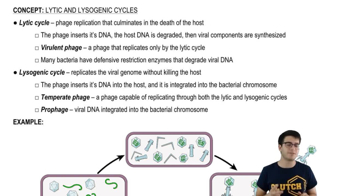
The lytic cycle is a viral replicative cycle that produces new phages and lyses the host cell, killing it.
What is the lysogenic cycle in phages?
The lysogenic cycle integrates viral DNA into the host chromosome as a prophage, replicating without killing the host until triggered to enter the lytic cycle.
How do bacteria defend against phages?
Bacteria use surface protein mutations, restriction enzymes to cut foreign DNA, and the CRISPR-Cas system to target and destroy phage DNA.
What is the CRISPR-Cas system?
A bacterial adaptive immune system that stores phage DNA sequences and uses Cas proteins to recognize and cut invading phage DNA.
How do animal viruses differ from bacteriophages?
Animal viruses often have RNA genomes and membranous envelopes, unlike most bacteriophages.
What is a retrovirus?
A retrovirus is an RNA virus that uses reverse transcriptase to copy its RNA genome into DNA, which integrates into the host genome as a provirus.
What is a provirus?
A provirus is viral DNA integrated permanently into the host genome, transcribed into RNA for viral protein synthesis and new virus genomes.
How do viruses evolve?
Viruses likely evolved from mobile genetic elements like plasmids and transposons and continue to evolve rapidly through mutation and recombination.
How do viruses cause disease in animals?
Viruses damage cells by lysing them, releasing enzymes, producing toxins, or having toxic molecular components.
What is a vaccine?
A vaccine is a harmless derivative of a pathogen that stimulates the immune system to defend against the harmful pathogen.
What causes emerging viral diseases?
Emerging viruses arise from mutation, spread from isolated populations, or transmission from animals to humans.
How do influenza viruses cause epidemics and pandemics?
Influenza viruses mutate rapidly and reassort their segmented RNA genomes, creating new strains that can cause widespread outbreaks.
How do plant viruses spread?
Plant viruses spread by horizontal transmission through damaged cell walls and vertical transmission from parent to offspring.
What are prions?
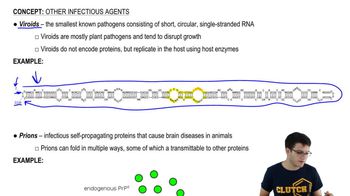
Prions are infectious misfolded proteins that cause degenerative brain diseases by converting normal proteins into the misfolded form.
 뒤로
뒤로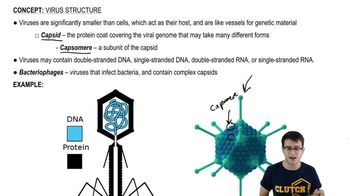
 05:00
05:00