Skip to main content
General Biology
나의 코스
배우기
시험 준비
AI 튜터
학습 가이드
교과서적 해결책
플래시카드
탐험해 보세요
앱을 사용해 보세요
나의 코스
배우기
시험 준비
AI 튜터
학습 가이드
교과서적 해결책
플래시카드
탐험해 보세요
앱을 사용해 보세요
뒤로
GRQ Chemistry Lesson 4
카드를 뒤집기 위해 탭할 수 있습니다.
Major atoms in biomolecules
카드를 뒤집기 위해 탭할 수 있습니다.
👆
Major atoms in biomolecules
Carbon, hydrogen, nitrogen, and oxygen
are the four major atoms that make up biomolecules.
진행 상황 추적
컨트롤 버튼이 '내비게이션' 모드로 변경되었습니다.
1/43
추천 영상
02:13
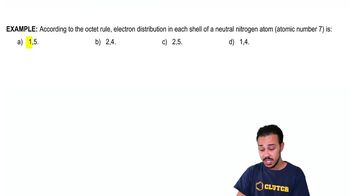
Atoms- Smallest Unit of Matter Example 1
26940
views
705
rank
2
comments
03:51
Atoms- Smallest Unit of Matter Example 3
17339
views
371
rank
1
comments
09:44
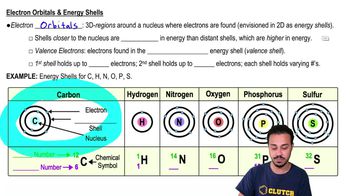
Electron Orbitals & Energy Shells
24323
views
502
rank
이 집합의 용어 (43)
하이드의 정의
Major atoms in biomolecules
Carbon, hydrogen, nitrogen, and oxygen
are the four major atoms that make up biomolecules.
Atoms directly involved in chemical reactions
Electrons
are the subatomic particles directly involved in chemical reactions.
Electron energy gain effect
When an electron gains energy, it moves to a more
outer shell
.
Chemical behavior of an atom depends on
The chemical behavior depends mostly on the number of electrons in the
outer (valence) shell
.
Hydrogen outer shell electrons and needs
Hydrogen has
1 electron
in its outer shell and needs
1 more electron
to fill it.
Carbon outer shell electrons and needs
Carbon has
4 electrons
in its outer shell and needs
4 more electrons
to fill it.
Nitrogen outer shell electrons and needs
Nitrogen has
5 electrons
in its outer shell and needs
3 more electrons
to fill it.
Oxygen outer shell electrons and needs
Oxygen has
6 electrons
in its outer shell and needs
2 more electrons
to fill it.
Relation of periodic table to outer shell electrons
The periodic table groups elements by the number of electrons in their
outer shell
.
Atoms in chemical bonds
Atoms either
share
or
transfer
valence electrons to form chemical bonds.
Ionic bonds in watery solutions
Ionic bonds are generally
weak
in watery environments because water disrupts ionic interactions.
Single vs double covalent bond
A single covalent bond shares
one pair
of electrons; a double covalent bond shares
two pairs
.
Number of covalent bonds atoms can make
Hydrogen: 1
,
Carbon: 4
,
Nitrogen: 3
,
Oxygen: 2
.
Most electronegative atom in biological molecules
Oxygen
is the most electronegative atom, meaning it strongly attracts electrons.
Polar covalent bond
A bond where electrons are shared unequally due to differences in
electronegativity
.
Carbon-hydrogen bond polarity
The bond between carbon and hydrogen is
nonpolar
due to small electronegativity difference.
Hydrogen-oxygen bond polarity
The bond between hydrogen and oxygen is
polar
because of a large electronegativity difference.
Meaning of Greek letter delta (δ) in bonds
δ indicates a
partial charge
on an atom in a polar covalent bond.
Ionic bond electron transfer example
Electrons transfer from sodium to chlorine, filling their outer shells and forming ions.
Cation and anion definitions
A
cation
is a positively charged ion; an
anion
is a negatively charged ion.
Hydrogen bond definition
A weak interaction between a hydrogen atom with a partial positive charge and an electronegative atom.
Atoms involved in biological hydrogen bonds
Hydrogen bonds often form between hydrogen and
oxygen
or
nitrogen
atoms.
Why water's covalent bonds are polar
Oxygen's high electronegativity causes unequal sharing of electrons, making water bonds polar.
Van der Waals interactions
Temporary positive and negative regions form by chance in nonpolar molecules, enabling weak attractions.
Strongest bonds in biological systems
Covalent bonds
are the strongest bonds in biological systems based in water.
Weak interactions holding molecules together
Hydrogen bonds, ionic bonds, and van der Waals interactions
are weak individually but collectively strong.
Biological concept illustrated by opiates binding receptors
Molecular
shape complementarity
allows drugs to bind the same receptors as natural molecules.
Definition of hydrocarbon
Organic molecules made of only carbon and hydrogen, mostly with
nonpolar
bonds and hydrophobic.
Common chemical groups in biological molecules
-CH3, -OH, -COOH, C=O, OPO3^2-, -NH2
are key functional groups.
Polymer vs monomer
A
polymer
is a large molecule made of repeating
monomers
.
Protein as polymer or monomer
Proteins are
polymers
made of amino acid monomers.
Dehydration reaction
A reaction that
builds polymers
by removing water.
Hydrolysis reaction
A reaction that
breaks down polymers
by adding water.
Digestion reaction type
Digestion is a
hydrolysis
reaction.
Polarity of sugars
Sugars are mostly
polar (hydrophilic)
due to many hydroxyl groups.
Polymers of sugars
Polymers of sugars are called
polysaccharides
.
Lipids polarity
Lipids mostly contain hydrocarbons and are generally
hydrophobic
.
Composition of a triglyceride (fat)
A triglyceride consists of
three fatty acids
linked to a glycerol molecule.
Saturated vs unsaturated fatty acids
Saturated fats have no double bonds; unsaturated fats have one or more double bonds.
Physical state of fats at room temperature
Most animal fats are saturated and solid; unsaturated fats are liquid at room temperature.
Phospholipid structure and water interaction
Phospholipids have a hydrophilic head that interacts with water and hydrophobic tails that do not.
Phospholipid arrangement in water
Phospholipids form bilayers with heads facing water and tails inside, creating membranes.
Steroid structure and examples
Steroids have four fused rings; examples include sex hormones.
 뒤로뒤로
뒤로뒤로
 02:13
02:13