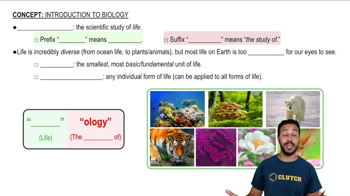
What is the fundamental organizing principle of biology?
Evolution is the fundamental organizing principle of biology and the core theme of the study of life.
What are the five unifying themes of biology?
Organization, Information, Energy and Matter, Interactions, and Evolution.
What are emergent properties in biological organization?
New properties that arise at each level of biological organization due to new arrangements and interactions of parts as complexity increases.
What is the basic unit of structure and function in living organisms?
The cell is the fundamental unit of structure and function in all living things.
How are multicellular organisms structurally organized above the cellular level?
Similar cells form tissues, tissues form organs, and organs form organ systems.
What distinguishes prokaryotic cells from eukaryotic cells?
Prokaryotic cells lack a nucleus and membrane-enclosed organelles, while eukaryotic cells have a nucleus and various membrane-bound organelles.
What is DNA's role in cells?
DNA stores genetic information that directs cell activities and is the substance of genes, the units of inheritance.
Describe the structure of DNA.
DNA is composed of two long strands forming a double helix, made up of four nucleotides: A, G, C, and T.
What is gene expression?
The process by which information in a gene is transcribed into RNA and then translated into a specific protein.
What is genomics?
The large-scale study and comparison of whole sets of genes and genomes of different species.
How do living organisms obtain and use energy?
Organisms transform energy, often from sunlight via photosynthesis, into chemical energy stored in molecules like sugar, which is then used to power cellular activities.
What is the difference between energy flow and chemical nutrient cycling in ecosystems?
Energy flows through ecosystems (entering as light and exiting as heat), while chemical nutrients recycle within ecosystems.
What is negative feedback in biological systems?
A regulatory mechanism where the accumulation of an end product slows down the process that produces it.
What is positive feedback? Give an example.
A process where an end product speeds up its own production; for example, blood clotting where platelets attract more platelets to seal a wound.
What is evolution according to biology?
Evolution is the process by which organisms descend with modification from common ancestors, explaining both unity and diversity of life.
What are the three domains of life?
Bacteria, Archaea (both prokaryotes), and Eukarya (all eukaryotes).
What is natural selection?
A mechanism of evolution where individuals with traits better suited to their environment tend to produce more offspring, increasing those traits in the population.
What is the scientific method?
A process of inquiry involving making observations, forming hypotheses, making predictions, and testing them through experiments.
What is a controlled experiment?
An experiment comparing an experimental group and a control group that differ only in one variable to test its effect.
How does science differ from everyday use of the word 'theory'?
In science, a theory is a broad, well-supported explanation that generates testable hypotheses, unlike the everyday meaning of untested speculation.
Why is cooperation important in science?
Science is a social activity where sharing data, repeating experiments, and peer review ensure reliability and progress.
How do science and technology differ?
Science aims to understand natural phenomena, while technology applies scientific knowledge for practical purposes.
Why is diversity among scientists valuable?
Diverse backgrounds and viewpoints enhance creativity, problem-solving, and the overall progress of science.
 뒤로
뒤로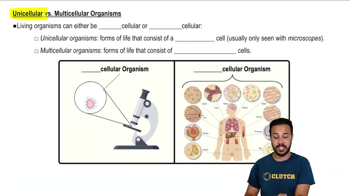
 02:09
02:09