 뒤로
뒤로Introduction to Evolution and Natural Selection
 03:22
03:22
이 집합의 용어 (20)
Fitness is the likelihood that an individual contributes offspring to the next generation.
Natural selection leads to adaptation, which is a trait that makes an organism well-suited to its environment.
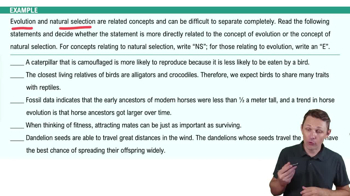
Natural selection is an explanation for how evolution happens.
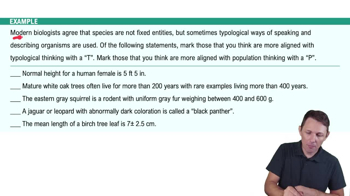
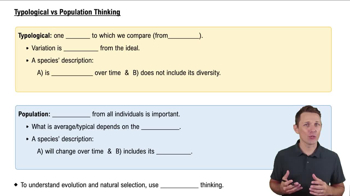
Typological thinking focuses on an ideal form and sees variation as deviation. Population thinking considers variation among all individuals as important and sees species as changing over time.
Population thinking is used to understand evolution and natural selection.
Ladder thinking arranges species in a hierarchy from low to high complexity, implying species are unchanging.
Tree thinking organizes species based on evolutionary relationships through common descent, recognizing species change over time.
A phylogenetic tree is a diagram showing species' evolutionary relationships based on common descent.
Branches represent lineages over time, and nodes represent common ancestors.
Relatedness is determined by the most recent common node (ancestor) shared between species.
Common descent explains that many similarities between species exist because they were inherited from the same ancestor.
Adaptation is a trait that increases an organism's fitness by making it better suited to its environment.
Variation among individuals is essential in population thinking because it drives evolution and natural selection.
Natural selection increases the frequency of traits that improve fitness and decreases those that reduce it.
Evolution occurs over many generations, while natural selection is the process that causes evolutionary change.
Typological thinking fails to consider the diversity and variation within a species.
Population thinking requires considering the full variation present in nature, which is crucial for understanding evolution.
The Great Chain of Being is a ladder thinking concept ordering species from low to high complexity.
Tree thinking focuses on evolutionary relationships and common ancestry, while ladder thinking focuses on species hierarchy and complexity.
The most recent common ancestor is the node where the branches leading to the two species meet.