 뒤로
뒤로Lesson 2 - Scientific Thinking
 07:36
07:36
이 집합의 용어 (21)
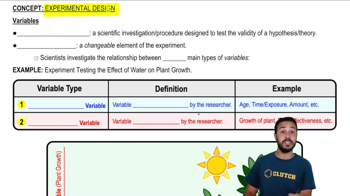
The independent variable is the variable that is tested or manipulated by the researcher.
The dependent variable is the outcome or factor measured in response to changes in the independent variable.
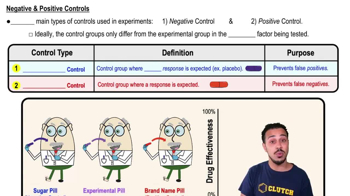
The control group is the baseline group that does not receive the experimental treatment, used for comparison.
The experimental group receives the treatment or condition being tested in the experiment.
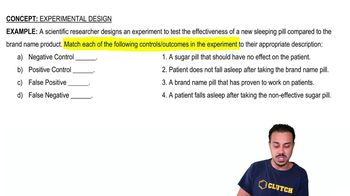
A positive validity control ensures the experiment works by producing a known positive result.
A negative validity control ensures the experiment works by producing a known negative result.
The wild-type enzyme activity decreases more sharply than the mutant enzyme as galactose concentration increases.
The mitotic index is the percentage of cells undergoing mitosis (cell division) at a given time.
p53 blocks cell division after DNA damage to prevent replication of damaged cells, acting as a tumor suppressor.
The mutant p53 allele is recessive because two mutant alleles are needed to show the mutant phenotype.
Cells with two disrupted p53 alleles continue dividing despite DNA damage, increasing cancer risk.
Positive controls confirm the test can detect the virus; negative controls confirm no contamination or false positives.
The test is inconclusive and may be a false positive; results cannot be trusted.
The control group (e.g., unbagged lettuce) provides a baseline to compare contamination levels against the experimental group.
They confirm the methodology works correctly and results are trustworthy by showing expected positive or negative outcomes.
Experimental group: weed seedlings treated with Chemical X.
Control group: untreated weed seedlings.
Independent variable: Chemical X treatment.
Dependent variable: seedling growth or emergence.
Weed seedlings treated with Chemical X do not emerge or grow, unlike untreated control seedlings.
The amount of scarlet protein (normal, absent, or increased) is the independent variable.
The eye color (presence and intensity of pigment) is the dependent variable.
Knockout butterflies have pale or white eyes due to lack of normal pigment.
Because correlation alone does not prove one factor causes another; controlled experiments are needed to determine causation.