Skip to main content
General Biology
나의 코스
배우기
시험 준비
AI 튜터
학습 가이드
교과서적 해결책
플래시카드
탐험해 보세요
앱을 사용해 보세요
나의 코스
배우기
시험 준비
AI 튜터
학습 가이드
교과서적 해결책
플래시카드
탐험해 보세요
앱을 사용해 보세요
뒤로
Lesson 3 Cells, PPT
카드를 뒤집기 위해 탭할 수 있습니다.
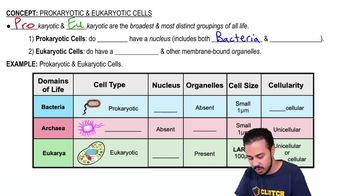
What are the two broad types of cells?
카드를 뒤집기 위해 탭할 수 있습니다.
👆
What are the two broad types of cells?
Prokaryotic
and
eukaryotic
cells.
진행 상황 추적
컨트롤 버튼이 '내비게이션' 모드로 변경되었습니다.
1/20
추천 영상
04:26
Recap: Prokaryotic vs. Eukaryotic Cells
21021
views
349
rank
05:54
Prokaryotic & Eukaryotic Cells
35583
views
760
rank
4
comments
03:54
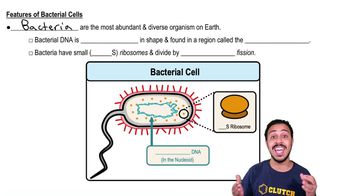
Features of Bacterial Cells
25386
views
435
rank
1
comments
이 집합의 용어 (20)
하이드의 정의
What are the two broad types of cells?
Prokaryotic
and
eukaryotic
cells.
Where is DNA found in prokaryotic cells?
DNA is found in the cytoplasm in a region called the
nucleoid
, which is not membrane-enclosed.
Where is DNA found in eukaryotic cells?
DNA is enclosed within a
nucleus
surrounded by a double phospholipid membrane.
Which cell type has membrane-enclosed organelles?
Eukaryotic cells
have membrane-enclosed organelles; prokaryotic cells do not.
Do prokaryotic cells have histones for DNA packaging?
No, prokaryotic cells do not have histones; eukaryotic cells do.
What is the significance of mitochondria and chloroplasts having their own circular DNA?
It supports the
endosymbiosis theory
, suggesting these organelles originated from free-living prokaryotes.
Who proposed the endosymbiosis theory and when?
Dr. Lynn Margulis first proposed it in the 1960s.
What is the goal of antibiotic research related to prokaryotes?
To find compounds that kill bacteria without harming animal cells by targeting differences between prokaryotic and animal cells.
Which bacterial structure is the best target for antibiotics?
The
cell wall
is a good antibiotic target because it is present in prokaryotes but absent in animal cells.
Are genome sizes proportional to organism complexity?
No, genome size does not predict organism complexity.
Are the number of genes proportional to genome size?
No, gene number is not proportional to genome size; humans have fewer genes per Mb than yeast.
How are genes organized differently in complex eukaryotes compared to prokaryotes?
Complex eukaryotes have larger genes, more non-coding DNA, and genes spaced farther apart.
What is chromatin?
In eukaryotes, DNA combined with histone proteins forms
chromatin
.
What is the typical path of a newly synthesized plasma membrane protein in a eukaryotic cell?
Rough endoplasmic reticulum (RER) → Golgi apparatus → plasma membrane.
Where does protein translation occur in eukaryotic cells?
On free ribosomes in the cytosol and on ribosomes attached to the rough endoplasmic reticulum.
How does a protein get targeted to the rough endoplasmic reticulum (RER)?
By the presence of a
signal peptide
at the N-terminus of the growing polypeptide.
What role does the signal-recognition particle (SRP) play in protein targeting?
SRP binds the signal peptide, pauses translation, and directs the ribosome to the ER membrane.
What happens to the signal peptide after the protein enters the ER?
The signal peptide is cleaved off by an enzyme in the ER membrane complex.
What is cystic fibrosis caused by at the protein level?
A defective CFTR protein that cannot be properly exported to the plasma membrane, impairing chloride ion transport.
How do CFTR modulators like Orkambi work?
They help defective CFTR reach the membrane (Lumacaftor) and increase its activity once there (Ivacaftor).
 뒤로뒤로
뒤로뒤로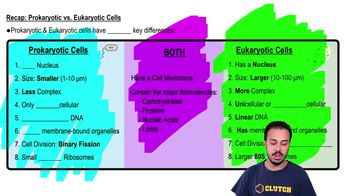
 04:26
04:26