뒤로

Meiosis and Sexual Life Cycles - General Biology

컨트롤 버튼이 '내비게이션' 모드로 변경되었습니다.
1/20
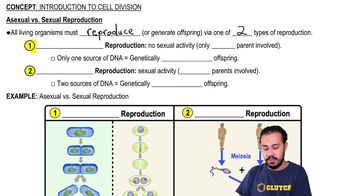
  • What is the main difference between sexual and asexual reproduction?

    Asexual reproduction produces genetically identical offspring from one parent, while sexual reproduction combines DNA from two parents to produce genetically unique offspring.
  • What are homologous chromosomes?

    Homologous chromosomes are pairs of chromosomes, one from each parent, that have the same genes at the same loci but may have different alleles.
  • Define diploid and haploid.

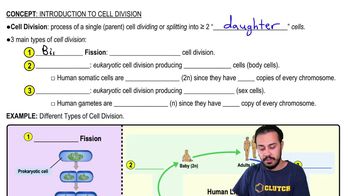
    Diploid (2n) cells have two sets of chromosomes, one from each parent. Haploid (n) cells have one set of chromosomes, typical of gametes.
  • What is the chromosome number in human somatic cells and gametes?

    Human somatic cells are diploid (2n = 46), and gametes are haploid (n = 23).
  • What is the purpose of meiosis?

    Meiosis produces four non-identical haploid gametes from one diploid precursor cell, enabling sexual reproduction.
  • How many daughter cells are produced by mitosis and meiosis respectively?

    Mitosis produces 2 identical diploid daughter cells; meiosis produces 4 non-identical haploid daughter cells.
  • What happens during prophase I of meiosis?

    Chromosomes condense, homologous chromosomes pair, and crossing over (homologous recombination) occurs at chiasmata.
  • What is independent assortment?

    Random alignment of homologous chromosome pairs during metaphase I leads to independent assortment, generating genetic variation.
  • What is nondisjunction and its consequence?

    Nondisjunction is the failure of chromosome pairs or sister chromatids to separate properly, leading to gametes with abnormal chromosome numbers.
  • What chromosomal abnormality causes Down syndrome?

    Down syndrome is caused by trisomy 21, having three copies of chromosome 21 instead of two.
  • What is a karyotype and when is the best time to perform it?

    A karyotype is an arranged display of chromosomes, best performed during metaphase when chromosomes are most condensed.
  • What are sister chromatids?

    Sister chromatids are two identical copies of a chromosome connected at the centromere, formed after DNA replication.
  • Describe the phases of mitosis in order.

    Phases: Prophase (chromosomes condense), Metaphase (chromosomes align), Anaphase (sister chromatids separate), Telophase (nuclear envelope reforms), followed by cytokinesis.
  • How does meiosis I differ from meiosis II?

    Meiosis I separates homologous chromosomes, meiosis II separates sister chromatids.
  • Why do diploid organisms need specialized sex cells?

    Specialized sex cells (gametes) are haploid, allowing fusion during fertilization to restore diploid chromosome number.
  • What is the significance of crossing over?

    Crossing over exchanges genetic material between homologous chromosomes, increasing genetic diversity in gametes.
  • What is the haploid number (n) for a mouse with 40 chromosomes?

    The haploid number n is half the diploid number, so for 40 chromosomes, n = 20.
  • What is the role of spindle fibers during mitosis?

    Spindle fibers attach to chromosomes and pull sister chromatids apart during anaphase.
  • What is the difference between autosomes and sex chromosomes?

    Autosomes are chromosomes that do not determine sex; sex chromosomes determine the biological sex of an organism.
  • How many unique gametes can be produced by independent assortment with 2 chromosome pairs?

    With 2 pairs, independent assortment can produce 2^2 = 4 unique gametes.